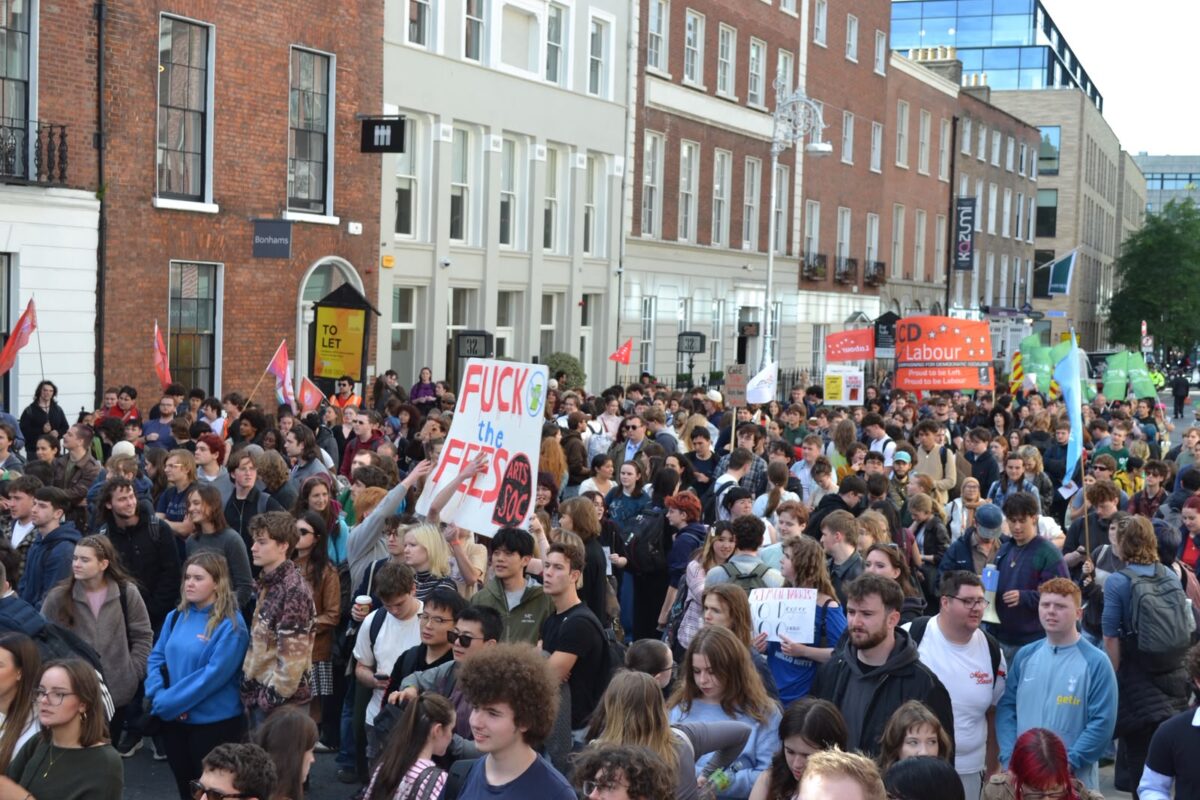

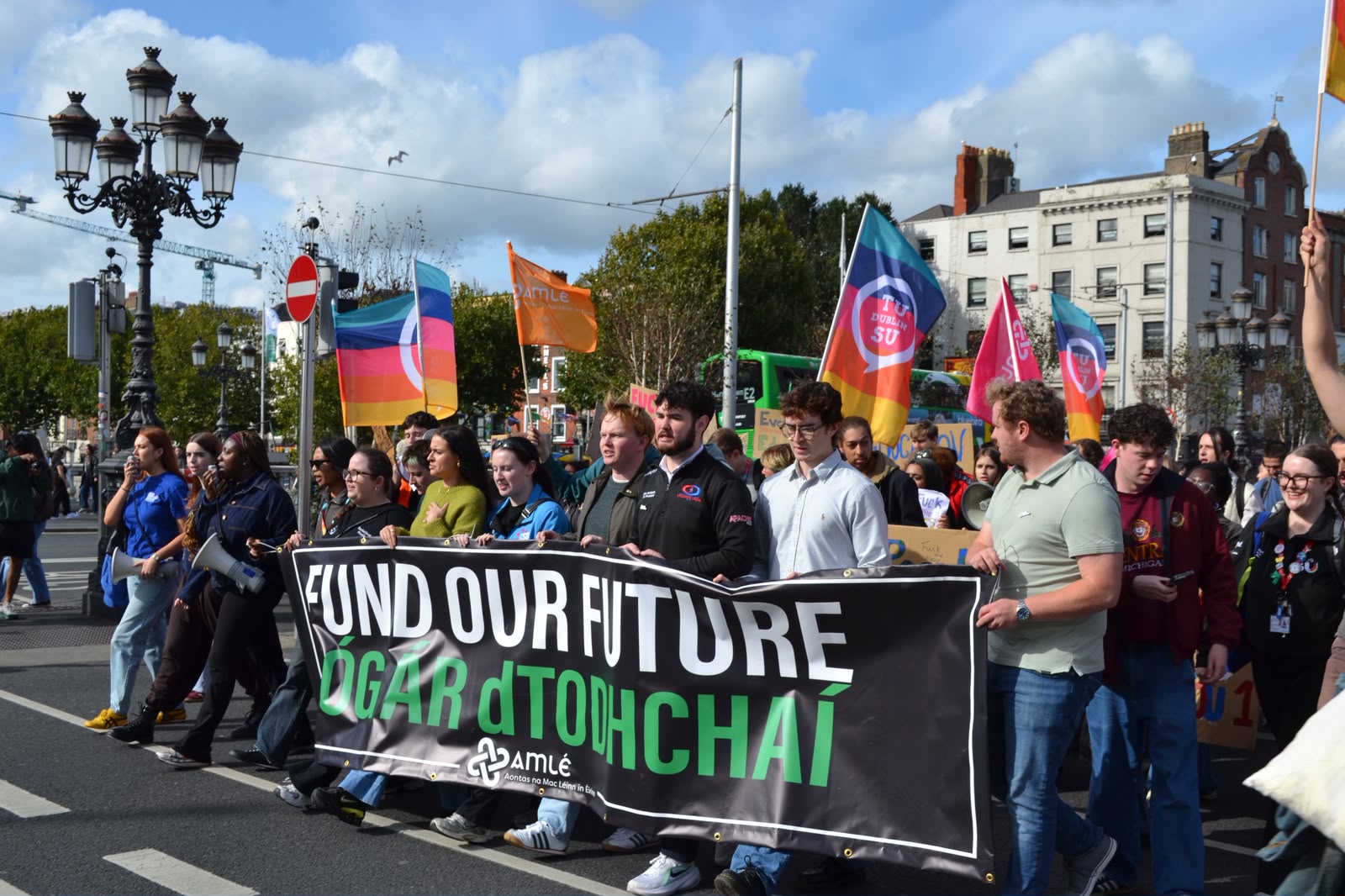
AMLÉ president Daniel Walsh announced that the protest marks the “largest student protest on student issues in the last 10 years”.
At 1 pm on the 1st of October 2026, over 3,000 Students protested as part of the ‘Fuck the fees; fund our future’ protest in Dublin City. This protest is the first nationwide student protest against the Student Contribution fee in years and was the largest student-led protest in Ireland in over 10 years. This protest was organised by the National Student Union AMLÉ (Aontas na Mac Léinn in Éirinn), with UCDSU playing a major role in its coordination.
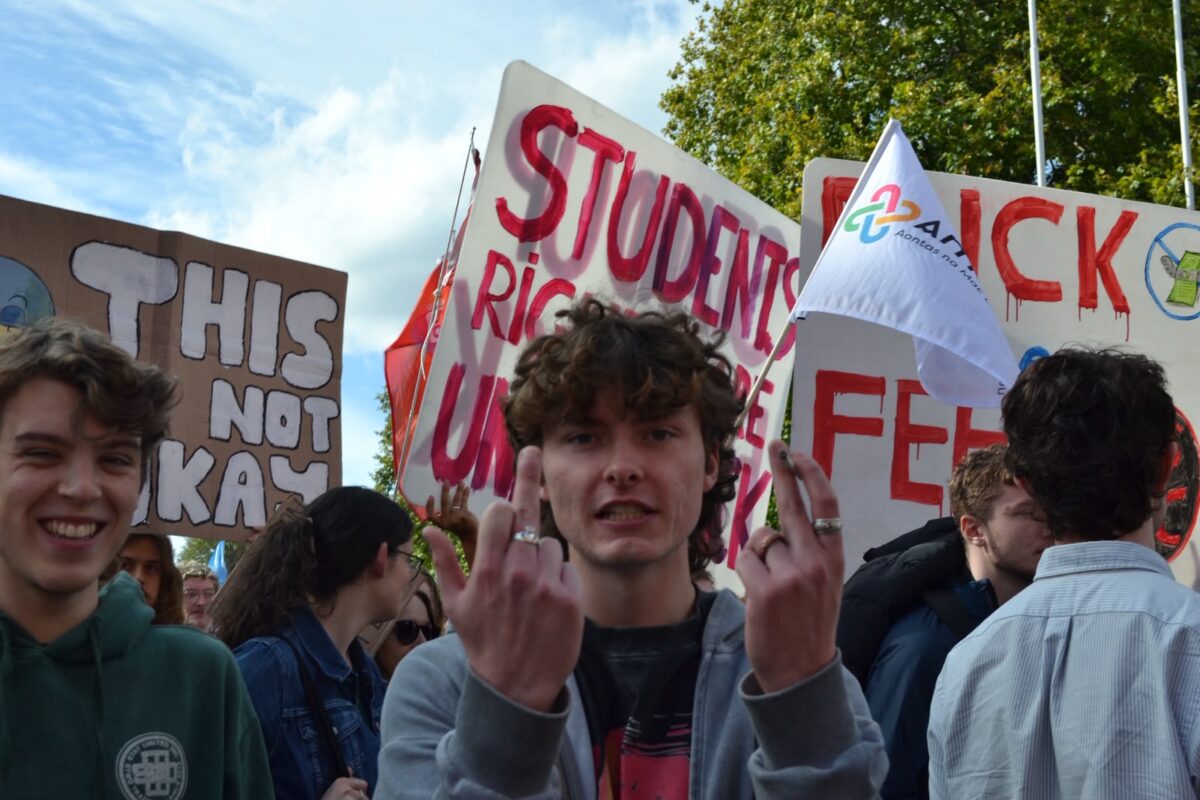
The protest began in the Garden of Remembrance, went through O’Connell Street, across the Liffey, Past Trinity College Dublin, through Dawson Street and finished outside the Dáil. During this march, protestors waved signs, flags, and banners and sang a number of different chants. These included chants such as “hey hey ho ho – Student fees have got to go”, “students sleeping on the floor- we won’t take it anymore”, and “We are the students, we won’t be silent, fund our future”.
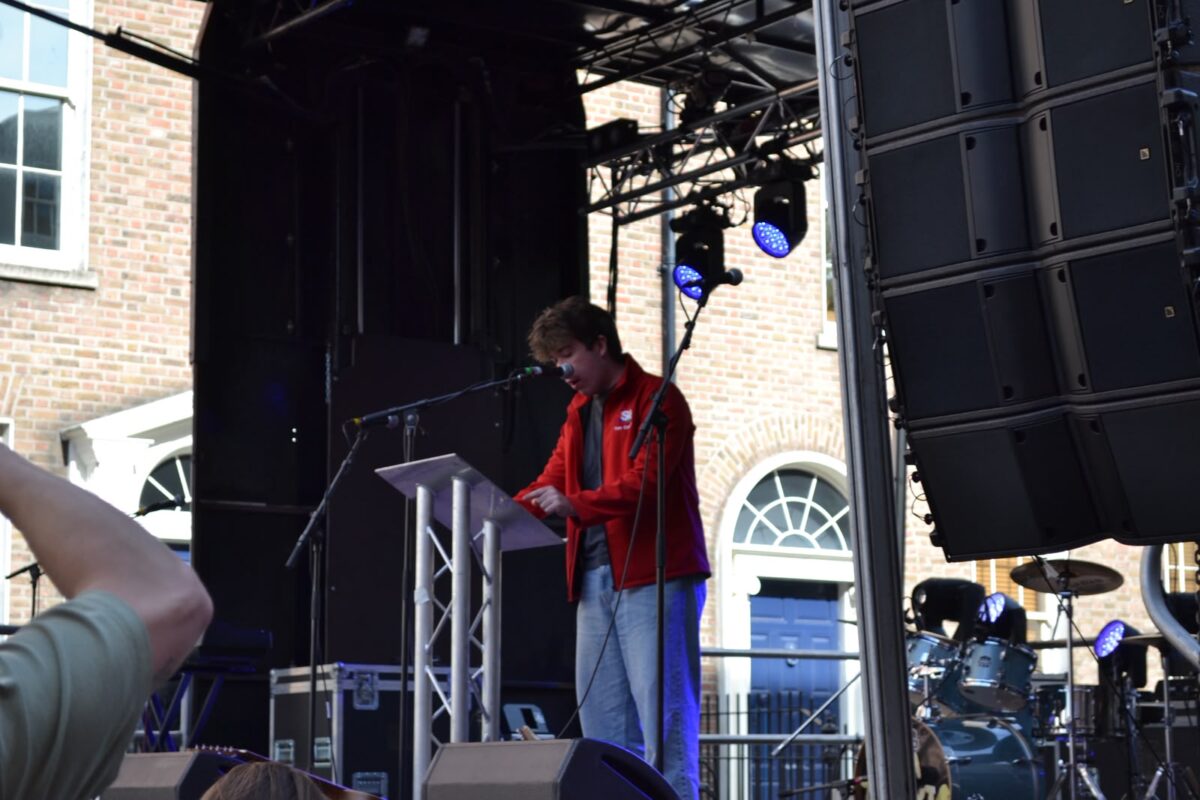
Outside the Dáil, the Dublin-based band “Na Tonnta” was playing music for protestors, motivating them for the rest of the protest. This was followed by several predominantly Student speeches, introduced and facilitated by AMLÉ President Daniel Walsh, who said that students were “back protesting again”. He said that the student movement had been “too compliant” over the last few years and argued that these protests were necessary to protest the government, which “has not helped struggling students”. He described this protest as the “first in a long line” and as the “dawn of a new day” for the student activism movement.
This was followed by Frank Jones from the Irish Federation of University Teachers (IFUT), who expressed solidarity with the students on behalf of the Irish Federation of Trade Unions, and drew attention to the IFUT’s industrial action set to start next week. Further speakers included Seán de Burca (President of the University of Galway SU), who focused on the housing crisis and cost of student accommodation across the country. Mina Eusebio (President of TUDSU) focused on specific challenges for technological Universities.
In contrast, Patrick McGrath (Vice-President – MTU Kerry Campus) focused on the issues commuting students face, including the cost of commuting and the loss of the University experience caused by long commutes. Emma Hogan (President of Trinity Student Union) outlined the issues of inadequate University funding, whilst Tom Conway from UCDSU concluded the Protest, re-outlining their key demands. Students who attended this protest stated that they were there to support AMLÉ’s core demands and to ask the Government to “fully fund the University Sector”.
A number of Irish opposition politicians attended the protest, including People Before Profit TD Richard Boyd Barrett, Sinn Féin TDs Louise O’Reilly and Pearse Doherty, Social Democrat TD Jen Cummins, Labour Senator Laura Harmon, and Green Party TD Roderick O’Gormann, who marched throughout the protest.
According to UCDSU’s Campaigns and Engagement Officer Tom Conway, the central aim of this protest is to “fuck the fees and fund our future”, meaning the total abolition of the Student Contribution Charge in Irish Universities. He added that this protest also advocates for long-term investment in the Student Accommodation Sector, full funding for the Irish University Sector, and the high quality of higher-level education in Ireland. This comes after the Government decision in Budget 2026 to permanently set the student contribution fee for undergraduate students at €2,500, and €2,000 for all students from households earning under €2,000. Whilst the Government argued that this was a reduction in fees, Students’ Unions, including UCDSU, argue that this was a € 500 increase in real terms from the previous year.
Conway clarified that while much of the promotion and discussion of the protest has centred around the Student Contribution Charge that Irish Undergraduate Students pay, AMLÉ’s demands extend to abolishing fees for both International and Postgraduate students. He argues that Irish Universities often charge non-EU students fees over €20,000 a year due to the lack of Government support in the University sector, and that Government investment would reduce this burden for International Students. When pressed, he clarified that he did not think this would lead Irish Universities to reduce places for international students, arguing instead that it would increase international students’ interest in Irish Universities.
According to the Director-General of the Irish Universities Association (IUA), Paul Johnston, the IUA “shares key objectives with AMLÉ”. In particular, they echo AMLÉ’s call to close the core funding gap, which,h according to Johnson,n is in “real terms over 250 million” and is “holding us (the University Sector) back” The IUA further shared AMLÉs concerns regarding additional student accommodation and asked the government to develop a strategy to provide the “affordable and viable accommodation students require”. Regarding the Student Contribution fees, the IAU supported calls to “ make education more affordable, particularly for students and families most in need”, but stopped short of joining calls for their abolition, underlining that any reduction in student contribution should not “come at the expense of funding to the sector itself”
Clarifying UCD’s position, Dean of Students Professor Jason Last said that “As a university,y we continue to use and support all the channels available to highlight the issues of financial and accommodation challenges faced by students, and financial challenges for the higher education sector” and that the student voice is vital and that the University supports all channels available to highlight such issues. According to Last, University Management has asked all those who support learning and other strident activities, “not academically to disadvantage those who wish to attend the protest.. Speaking on behalf of UCDSU, Conway welcomed this effort and stressed the need to build coalitions around common concerns, such as addressing the core sectoral funding gap.
This all comes ahead of Budget 2027, where decisions will be made on the future funding of the University Sector and the Student Contribution Charge, The Chair of UCDs Governing Authority Mike Beary, in collaboration with the Chairs of DCU, TCD, TUD, UL, and the University of Galway are asking for the Irish Government to increase core funding to the University sector by €190 million, as well as asking the government to “unlock some of the near 2 billion surplus in the National Training Fund for lifelong learning, upskilling and reskilling to future proof of workforce”.
The Minister for Higher Education, James Lawless, said he is “hopeful” next week’s budget will deliver significant support for students facing college fees. According to Minister Lawless, several fee-related measures are being negotiated, and he wants to deliver “significant support” on fees and reduce the overall cost of attending college, though he did not go into specifics. The program to government commits to “reduce the Student Contribution Fee over the lifetime of the Government “and Tánaiste and Minister for Finance Simon Haris committed during the 2024 General Election campaign to “abolishing the Student Contribution Charge”. There were divisions between government ministers and parties regarding this in 2025, and whilst such public disagreements have not repeated this year, significant negotiation is likely taking place in the Budget Negotiations,
Whilst the future of the Student Contribution Charge and University funding won’t be known until the budget is presented on the 6th of October, Conway is insistent that Students and stakeholders will continue fighting. When asked what USDSU will do if their demands are not met, Conway confirmed that they will protest again next year, saying it will be bigger and better and serve as a model to build upon.
Tom Andrews – News Editor