

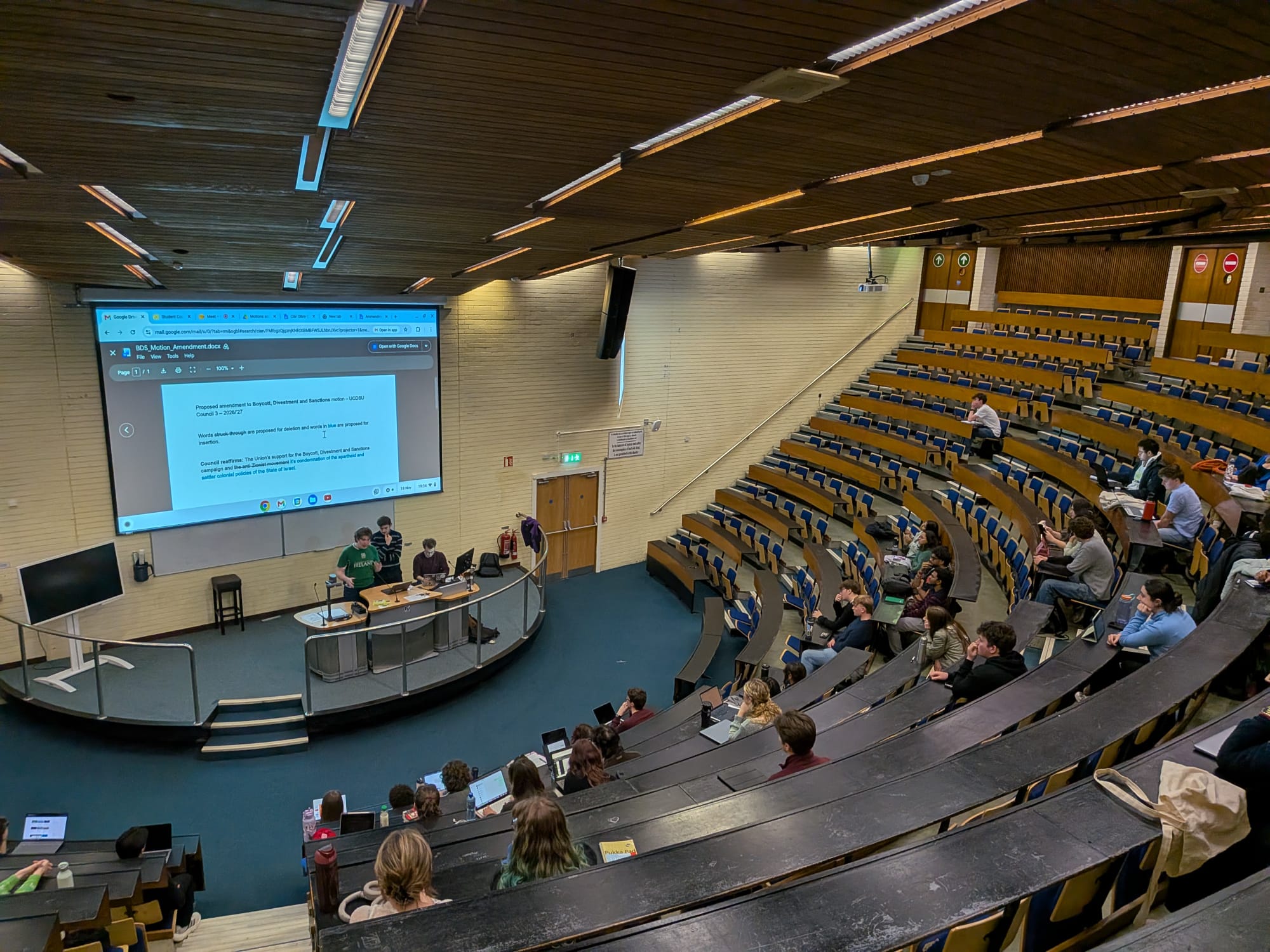
During the third UCDSU Council meeting on Wednesday, the 18th of November, an amendment was brought up against the use of the word ‘anti-zionism’ in the motion to uphold the BDS motion.
UCD Students’ Union has been mandated to support Palestine and the Boycott, Divestment, Sanctions (BDS) campaign since 2018. The most recent policy recently expired, and Welfare Officer, Éabha Hughes, proposed a motion to the union’s council to continue the Union’s support for the campaign.
President Enzo Crothers proposed an amendment to include a demand that the university cut ties with Israel, which passed.
There was contention over a second amendment, proposed by Engineering College Officer, Cian Spillane. The motion stated that Council reaffirms ‘The Union’s support for the Boycott, Divestment and Sanctions Campaign and the anti zionist movement. Spillane criticised the use of the term ‘anti-Zionism’ and sought to replace it with ‘its condemnation of the apartheid and settler-colonial policies of the state of Israel’.
“Anti-zionism would directly imply that Israel does not have a right to exist, and I have a major issue with us saying that you, as a country, don’t have a right to exist,” he said.
‘If we want to remain an anti-racist organisation, then we must remain an anti-zionist one,” Hughes responded, as applause rang through the room.
Speaking in favour of the amendment, Health Science College officer Seán Morrow said, “Anti-Zionism would directly imply that Israel does not have a right to exist.’
‘We’re not softening our position on the conduct of the Israeli state either, which is what people have a major issue with; we’re replacing one undefined word which calls for the eradication of an entire country, with a clear condemnation of specific policies.’
He further criticised the framing of the policy as a reaffirmation, as the 2023 policy did not use the phrase anti-Zionism. “A reaffirmation repeats what we have said; this motion includes something that we have never said and never defined.”
This was later contested by SU President Enzo Crothers, who stated, “There is precedent here. The Boycott, Divestment, Sanctions movement is an anti-Zionist one. Who are we boycotting, divesting from, sanctioning? Not Palestinians; we are sanctioning the state of Israel. It is an anti-Zionist movement.
Morrow went on to discuss another line from the motion that states council believes ‘That opposition to the actions of the Israeli state must never become hostility towards Jewish people’. “Saying that they don’t have a right to a country when less than 100 years ago, in our grandparents’ lifetime, 6 million of them were killed in the Holocaust – I think let’s draw a bit of comparison here and say you shouldn’t have a country; that is a test of actions and policies. The amendment follows that test. The fray anti-Zionist movement does not.’
In response, Tom Conway, Events and Engagements Officer, said, “Condemnation of the apartheid and settler-colonial policies of Israel is an anti-Zionist sentiment. Zionism is defined by apartheid and settler-colonialism. That’s the definition of it.
We believe all people should be safe in all countries. We believe Jewish people should be safe in this country and should not be held to account for some country they don’t feel connected to.
There were people there. It is an apartheid state that separates groups of people so that one is superior to another. It is a settler-colonial state. It went into an area in which there were already people and divided them, split them up and took, over the decades, more and more of their land.”
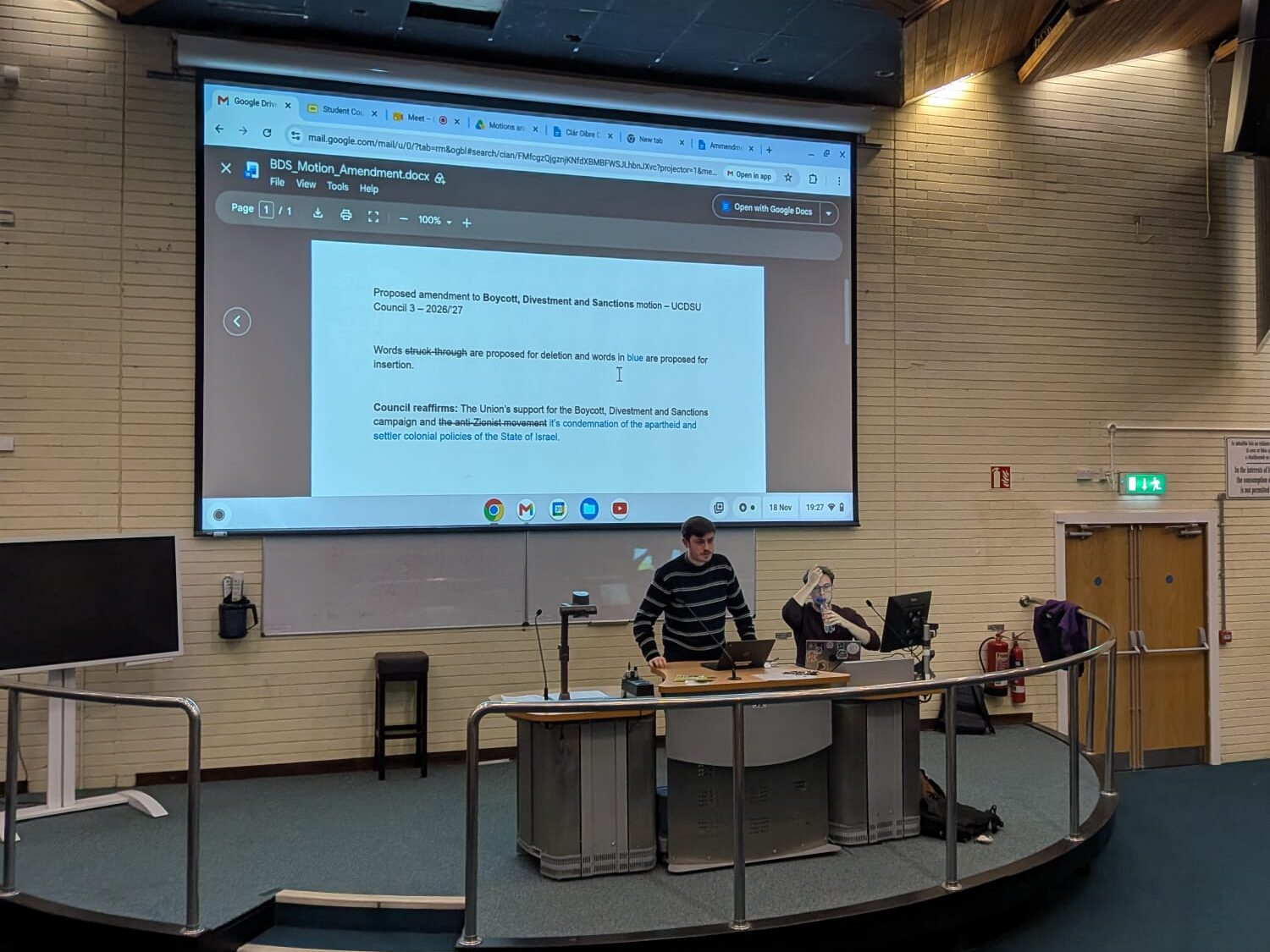
Another speaker began by emphasising that they “think what Israel is doing in Palestine is disgusting,” before arguing that “Zionism was created originally looking for a land, a home, a safe space for the Israeli people, especially following the Holocaust, where Jewish people were murdered, so I don’t really think it’s right to use the term Zionism and anti-Zionism in this motion.”
The SU President contested claims that the state of Israel came out of the Holocaust. “That is not true. The essay that Éabha cited (Vladimir Jabotinsky’s “The Iron Wall”) was written in 1923. Franz Kafka, also a known Zionist, wrote essays in the 1920s. This is a racist ideology that existed well before the atrocities committed by Nazi Germany. One atrocity does not give credence to allow for an additional atrocity to be brought on to an additional people.”
The proposed amendment failed to carry, with only 5 voting in favour in a room of over 70 members. The motion to continue the support of the BDS campaign did pass with an overwhelming majority.
Speaking to The College Tribune, Hughes said. ‘I would phrase it (the amendment) as a watered-down version of anti-Zionism. I think what we passed today was a really honest clarification of who we are as an organisation.’
By Sophie Gliott, Ellena Brady and Aisling Murphy