

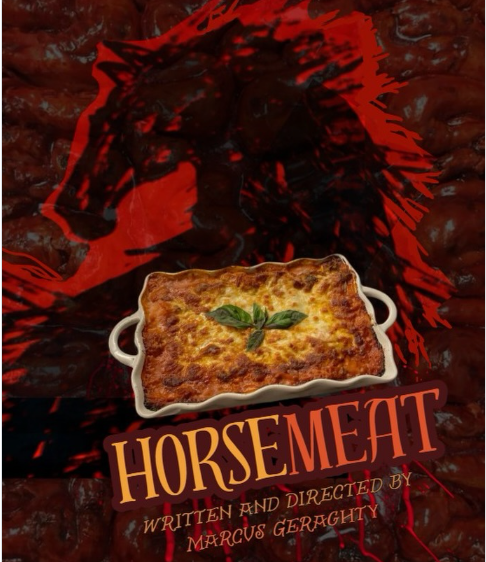
What do you get when you combine questionable lasagne, animal rights terrorism, and a man trapped inside a fridge? Apparently, Horse Meat.
Written and directed by Marcus Geraghty for UCD Drama Society, Horse Meat is an absurd and darkly comic play which manages to turn a bizarre premise into something surprisingly thought-provoking. After sitting in on one of the final rehearsals the day before the show, I had a much better idea of just how much goes into putting on a Drama Soc production, and more importantly, how much fun it looks like it is.
The rehearsal was collaborative and chaotic in the best way possible. Between running scenes, adjusting lines and laughing together, there was a real sense of friendship between the cast and director. It was particularly interesting to see how engaging the process was. Rather than simply watching actors learn their lines, I got a glimpse of everyone throwing ideas around and helping each other to figure out how the scenes should work. Hannah described the cast as “all just friends putting on a show together”, and after watching the rehearsal, that seemed pretty accurate. If this is what Drama Soc is like behind the scenes, it is easy to see why people get so involved.
The play began somewhat unexpectedly. Marcus came up with the idea while gardening in the summer of 2025. The initial thought developed from an old workplace incident where the quality of lasagne had been questioned, leading to the thought that “horse meat would be fun”. From there, the idea quickly developed into Johnny being trapped in a fridge with his boss while animal rights terrorists closed in. Marcus picked up his computer and began writing, producing the initial idea in a surprisingly short amount of time. “No drafting,” he explained, with the play coming together in a matter of hours. Five months later, it was being put on by Drama Soc, then again on the 16th and 17th of September for Drama Soc’s Inaugural Show.
The result is a play in which comedy and genuine moments of horror exist uncomfortably alongside one another. One central scene features Tadgh, played by Séan Brennan McLoughlin, trapped inside a fridge with his boss, Brennan, played by Sam Clements, who eventually dies. The audience is encouraged to laugh before being abruptly reminded that what is happening on stage is actually quite disturbing. A personal favourite scene for me was the opening scene, where Tadgh and Brennan are trapped and discussing a way to escape the animal rights terrorists, played by Hannah McDonald and Sam Gorman. The dynamic between Brennan and Tadgh was funny and sarcastic. It was pleasant to be among others who thought the same.
For Marcus, maintaining that balance was one of the biggest challenges of directing. “As a director, [I was] trying to find a balance between comedy and realness,” he explained. While Horse Meat is deliberately comedic, he wanted the deaths to retain their impact. The sudden movement between humour and seriousness creates a kind of jolt; as Marcus put it, he wanted the audience to laugh, “which will make the death scenes most impactful”. Rather than allowing the comedy to soften the violence, it makes those moments more uncomfortable. The cast also had to be conscious of this balance, particularly when some characters naturally leaned towards comedy.
The play also embraces its deliberately chaotic tone. Hannah, who describes her character as “absolutely unhinged”, sees the production as a commentary on “the absurdity in animal rights terrorism” and the lengths people will go to for what they believe in. The characters are convinced there isn’t horse meat in the lasagne, only to discover that there actually was. They believe themselves to be innocent, creating a situation where, as Hannah explained, “there is pokes of fun, but there is a level of truth to it.” The play takes animal rights activism to an extreme, poking fun at the characters while still acknowledging the seriousness behind their beliefs.
Yet beneath the absurdity, there is a recognisable human element. The characters genuinely believe they are innocent, while the audience is given reason to question assumptions. It is this gap between intention and reality that gives Horse Meat more substance than its premise initially suggests.
For Hannah, one of the most enjoyable aspects of the production was the freedom to develop her character. As her role was smaller, she felt she had “a lot of room to characterise the character the way I wanted to”, something Marcus encouraged by allowing her to play around with the role. She also emphasised the importance of the cast learning from one another, saying that “we all really value each other’s opinions”. She describes Drama Soc as a place to “make mistakes and grow from them”, with the relationship between the cast and Marcus being particularly collaborative. After watching the rehearsal, that seemed clear. There was a genuine sense that everyone involved had ownership over the production.
Marcus currently has no plans to expand Horse Meat, although he continues to write. Perhaps that is fitting. At its heart, Horse Meat is a play about taking an idea that sounds ridiculous and seeing just how far it can go. And after getting a small glimpse behind the scenes, I can safely say that whatever Drama Soc comes up with next, it will definitely be worth watching.
Suzannah Raben – Arts and Lifestyle Editor