

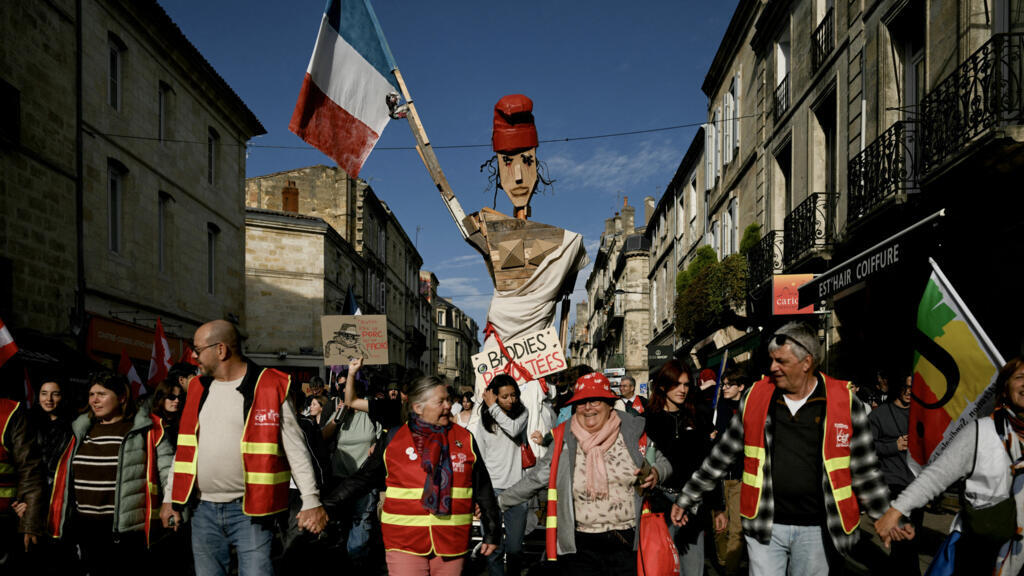
Born as a response to underfunding and poor conditions in public schools, the French school strike has grown into a nationwide movement. Student mobilisation has spread to members of the public service, employees, and, more generally, critics of the government’s lack of action to address the current high cost of living. Throughout the country, university students have blockaded campuses in solidarity with the protesters.
Among third-level students in France, 15% are international. To understand their perspective on the blockade alongside that of local people, we interviewed Maxime, a French secondary school student, and Myles, a UCD student from Ireland currently on Erasmus in Toulouse.
When the blockade began across the country, many demands were similar across all schools: as Maxime summed up, “We wished secondary school students to be guaranteed to have a teacher in front of them, clean study spaces, and adequate equipment to facilitate studying”. French secondary schools are also notorious for their busy schedules and the infamous 8 heures – 18 heures, classes from 8 am to 6 pm.
As Myles puts it, “education should be distributed at a stable and high quality for all students throughout the country regardless of income, position, geography”, in France as well as in Ireland. “The French understand unity against injustice in a very admirable way in that they are willing to bring their country to a grinding halt when they are not satisfied with how their government serves them”. The recent protests show that even in cases of police brutality, the French will continue protesting, and they do not plan on stopping until their demands have been listened to.
Three weeks ago, at the Sciences Po campus in Toulouse, all classes were cancelled by the university in response to student blockades. “Online learning was implemented without consulting the students”, says Myles, “and was pretty unsuccessful”. To maintain the blockade, students used loud music to disrupt classes, prompting faculty to abandon attempts to teach.
Left in a state of limbo, without structure or a developed support network, Erasmus and exchange students took matters into their own hands, forming an international general assembly. Once a group chat connected the international students, a handful of volunteers stepped forward to organise and chair the assemblies in one of the few buildings still open on campus. The assembly has met six times in the last two weeks and is serving as a channel of communication between French students and the administration.
“The majority of international students are in support of the blocus movement, but the blockades have been more divisive”, says Myles, who is one of the organisers. The assemblies have provided students the opportunity to voice their fears and frustrations, most frequently about limited visas, translating grades in home universities, and the impending exam season. With classes cancelled until further notice, it is unclear how exams are expected to go ahead.
Students have requested no retroactive mandatory attendance for online classes, no testing on topics taught online, and reasonable adjustments to exam format. According to Myles, “We need exam concessions after missing so much class time”.
Despite the disruption, the assembly explicitly supports the movement: “Our frustrations will not be weaponised against our French peers”. Thus far, there has been little indication from the university administration that these requests will be met.
UCD has been in regular contact with its Erasmus students in France, and coordinators have issued frequent security updates and encouraged students to make contact if they find themselves in distress. Still, while the blockade continues, little action can be taken.
On 17 October, over half a million people took to the streets across France. In Toulouse, an estimated 80,000 people gathered at Place Jeanne d’Arc in the city centre, before marching to protest soaring living costs. From 2 pm until almost midnight, the protestors encountered law enforcement, including rubber bullets, stun grenades and tear gas. Many protestors, including international students, came prepared with eye drops and face masks, while others retaliated with paint bombs and fireworks.
Across the country, protests have continued as the government has attempted concessions. In Toulouse, with the midterm break only a week away, many international students are left wondering how long the blockade will last, and what it will mean for them.
By: Lucie Soanirina-Bevazaha, Louise Tyner