
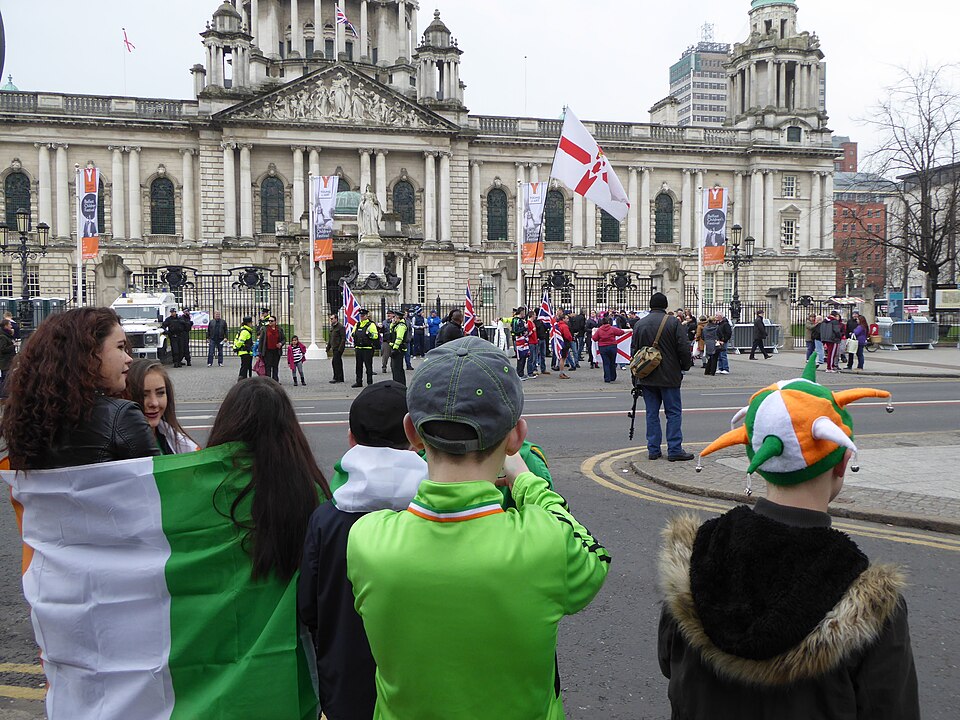
Anyone under the age of 28 was born after the signing of the Good Friday Agreement in April 1998. For them, the Troubles are something taught in school and remembered from family stories. The Agreement is a settlement they inherited, not one they chose. Yet this settlement contains a clause now returning to the centre of politics: the possibility of a vote on Irish unity. How a generation with no direct memory of the conflict relates to that clause may shape its eventual use.
Good Friday Agreement
The Agreement was the outcome of a long and violent history. The 1920s partition was designed to keep a unionist majority in Northern Ireland, but conflict ensued, and from the late 1960s, the Troubles killed more than 3,500 people. Initial attempts at a settlement failed, and only when the 1993 Downing Street Declaration stated that Britain had no strategic interest in Northern Ireland did a breakthrough become possible.
The 1998 Agreement drew on these earlier developments. It was approved by referendums, with roughly 71% in the North and 95% in the Republic. Those who voted for it knew what it was replacing: a period of violence and uncertainty.
The Agreement turned a military and constitutional issue into a peaceful and procedural question. The central idea was consent: Northern Ireland’s status changes only if a majority living there wishes it. The Secretary of State must call a referendum if a majority appears likely to vote for unity. The Republic rewrote Articles 2 and 3 of its constitution, replacing a territorial claim over the whole island with an aspiration to unity by consent.
Two features matter for what follows. First, “appears likely” is never defined, so the threshold for a poll is a matter of political judgement. Second, the Agreement hard-wired two communities into Stormont: the Northern Ireland Assembly members register as unionist, nationalist or other, and key votes require cross-community support. That made sense for those who experienced the conflict. However, it is a less obvious approach for those who did not.
The Shifting Landscape
The Agreement institutions have not run smoothly. Stormont has repeatedly been suspended and out of action. Then came Brexit, which changed the terms of the debate for good. Northern Ireland voted to remain in the EU in 2016 but left with the rest of the UK in 2020, putting the Irish border back at the centre of politics until the Windsor Framework of 2023.
Other changes have also accumulated. Sinn Féin became the largest party in the Assembly in 2022, producing the first nationalist First Minister in 2024. The 2021 Northern Ireland Statistics and Research Agency (NISRA) census recorded that, for the first time, there were more people from a Catholic background than a Protestant one in Northern Ireland. The Irish Government launched its Shared Island initiative in 2020, treating cross-island cooperation as official policy.
Each of these makes unity easier to imagine as a practical political conclusion, but recent polls suggest that a plurality of people in Northern Ireland remain opposed to leaving the UK, as found in United Ireland Polls. Nevertheless, the trend is towards unity: in 2019, 52% of Northerners backed staying in the UK, and 30% backed unity; today it’s 48% to 34%. The gap has shrunk from 22 points to 14. Still, the constitutional question remains unresolved.
A Generation the Agreement Did Not Plan For
The settlement assumed that people would sort themselves into two clean, distinctive camps. However, the generation now coming of age is less willing to do so. The designation as “neither” remains strong, as evidenced by the Alliance Party’s rise to third place in 2022, reflecting voters who reject the orange-green binary. In the 2025 NILT survey, 28% of people between 18 and 24 considered themselves “neither.” For 25-34, this number is 34%. This is a substantial portion that might decide the fate of the Agreement’s two-party structure.
University of Liverpool’s recent Northern Ireland survey found that more young people in the North support unification with the South, and this number is increasing. But there is a catch. The same study found no evidence of a pro-unification majority meeting the required 50+1 threshold. While the young people lean towards pro-unification, their political weight remains limited. Their voice is hindered by a low turnout, at only 32.1%, according to the Northern Ireland General Election Survey 2024, published by the Royal Irish Academy in 2025.
The question also means something different. For those who lived through the Troubles, the question carried the memory of violence. For the young, the conflict is an inherited legacy rather than a lived memory, and the Northern Ireland Attitudinal Survey suggests that many young people focus on practical issues when it comes to reunification: healthcare, the economy, and what a united Ireland would look like. This cuts both ways: the Union loses its inherited weight just as unity loses its taboo.
That is why a generation without a fixed identity may be better read as “unclaimed” rather than party devotees or loyalists. Many young people do not consider themselves to be affiliated with any party, and most don’t vote at all. Disillusionment with the Agreement’s two-bloc structure and the questions it has left open might explain this. What would a united Ireland look like: one unitary state, or something that preserves Northern Ireland’s institutions? What happens to the health service, British identity, and symbols such as the flag and anthem? The Agreement says nothing about the transition after a vote.
Brexit itself can serve as a cautionary tale precedent here. A referendum held without a settled proposition produced years of argument over what had actually been chosen. Those who will decide a future border poll likely want the answer to that before they cast a ballot.
Inheritance or decision?
This generation did not write the Agreement, and the Agreement did not anticipate them. They have inherited both peace and unresolved constitutional questions without direct memory of either the conflict or the compromise that ended it. A large share of them reject the Agreement’s two-bloc structure, creating a potentially decisive group outside the two-bloc system: the unclaimed.
However, an even larger number of the youth stay away from the ballot box altogether. They are unclaimed, but also unmotivated. Unless they vote, they decide nothing. Whether the young generation comes to ratify the settlement, rework it or leave it behind will shape what Irish unity means, and whether it comes at all.
By: Jasper Liitiäinen