

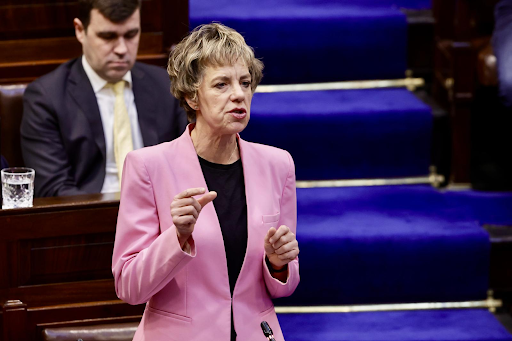
Irish politics has a habit of turning questions of principle into questions of political survival. Few individuals understand this better than Labour Party leader Ivana Bacik, whose opposition to the government has often centred on the gap between its stated ambitions and their practical consequences.
For a party with a long history in Irish government, Labour now faces a familiar but uncomfortable question: what does it stand for when it is not in power? In an interview with The College Tribune, Bacik discussed the realities of a party seeking to distinguish itself through a politics rooted in workers’ rights, public investment and international solidarity.
Labour’s Alternative Budget 2027 set out a competing vision for public spending, prioritising measures to alleviate the cost-of-living crisis, reduce energy costs, tackle child poverty and accelerate investment in public infrastructure. Reflecting on the Coalition’s fiscal approach, Bacik had described it as a “KitKat budget for a TikTok Tánaiste” (a riposte aimed at Tánaiste and Finance Minister Simon Harris).
“I said it somewhat flippantly,” she said, “but it was a serious point, because the raises that were given amounted to no more than the price of a chocolate bar per week.” Bacik further argued that government budgetary measures would be “eaten up by inflation”, alongside the rising costs of energy, fuel and groceries. “When we see inflation running at 4%, the government’s approach really fell far from what was required,” she said.
The passing of the Defence (Amendment) Bill on 21 October in the Dáil marked a significant shift in Ireland’s longstanding military neutrality arrangements, removing the requirement for United Nations authorisation as part of the “Triple Lock” for the deployment of Irish Defence Forces overseas. The legislation, which Labour strongly opposed, represented what Bacik viewed as an undermining of Ireland’s established role in international peacekeeping.
“The Labour Party is very much in support of our neutrality, and indeed, in support of the triple lock,” she said, emphasising the party’s opposition to the government’s proposed changes. Bacik argued that Irish troops had developed a distinguished international reputation through their service under the United Nations’ Blue Beret, describing the country’s peacekeeping tradition as closely aligned with its commitment to internationalism and military neutrality.
However, Bacik identified a further concern with the legislation, arguing that the government’s justification for removing the Triple Lock overlooked an existing alternative within the UN system. She pointed out that the current arrangements did not specifically require a mandate from the UN Security Council. Still, they could also be authorised by the UN General Assembly, in which neither Russia nor the United States holds veto power.
“We agree with the government that it’s dangerous to continue to allow Russia, for example, to have a veto,” she said. “Now is not the time to start undermining the UN, as the Irish government is seeking to do.”
Turning to the government’s handling of Palestinian student visas, Bacik was similarly critical of what she described as an increasingly restrictive approach to migration. The Department of Justice’s refusal of visas to Palestinian students, many of whom had secured fully funded scholarships at UCD and other Irish universities, was an issue she said had caused considerable distress among those affected.
As a party with a longstanding record of solidarity with Palestine, Bacik said Labour had stood alongside Students’ Unions protesting the decisions. She was particularly critical of Minister for Justice Jim O’Callaghan, accusing him of making a “sharp right-turn on migration”.
“I think it’s appalling to see Jim O’Callaghan’s behaviour on this,” she said, describing the refusal of visas to students from a war zone, many of whom were from what she referred to as a genocide zone in Gaza, as “appalling treatment”.
“I have called on the Minister now to review his decisions urgently on all those refusals and to overturn them,” Bacik said, arguing that the government should not leave students waiting for individual High Court judgments to determine their ability to enter Ireland. “We’re seeing this is causing huge delays and distress,” the Labour leader added.
She also highlighted what she considered a significant inconsistency across government departments, citing the Department of Further and Higher Education’s encouragement of universities to offer scholarships and attract international students.
“There’s a really strange inconsistency in government here,” she said, arguing that the Department of Justice appeared not to have considered the wider government’s efforts to attract international students.
The discussion of Palestine extended beyond student visas to the Occupied Territories Bill, which sought to prohibit trade with Israeli settlements in occupied Palestinian territory. Labour, Bacik explained, had supported a more comprehensive version of the legislation from its early stages, having co-sponsored it with Senator Frances Black during her time in the Seanad.
“We’ve supported it and indeed supported the inclusion of services as well as goods throughout the process,” Bacik said. “It’s disappointing that the government bill did not include trade and services.”
“The bill clearly does not go far enough,” she said, reiterating the party’s position that a more comprehensive approach was both legally viable and necessary. Labour had consistently advocated for the inclusion of both goods and services, maintaining that such provisions would not breach European Union law, despite the government’s concerns.
Bacik also welcomed the progress other countries had made on the question of severing trade ties with Israeli settlements in Palestine, highlighting developments in the United Kingdom. “I do very much welcome the fact that the Labour government in Britain under Andy Burnham is also making moves on this issue,” she said.
For Bacik, the legislation carried significance beyond its immediate economic consequences. She described its impact as “twofold”: first, as a symbolic expression of condemnation of Israel’s actions in Gaza and its wider treatment of Palestinians; and second, as a practical measure capable of impeding trade between Israel and the European Union.
She also pointed to Labour MEP Aodhán Ó Ríordáin’s campaign calling for the suspension of the EU-Israel trade agreement, arguing that action at the European level could represent a considerably more substantial intervention than the restrictions contained within the Occupied Territories Bill alone.
“He’s running a big campaign… he’s calling on the EU to suspend the EU-Israel trade agreements. So, this would be a much bigger and even more tangible implementation than the prohibition on trade from the Occupied Territories Bill,” Bacik said.
Concluding the interview, Bacik encouraged greater political engagement among younger generations, particularly UCD students, whom she urged to join the Labour Party. Describing Labour as a party of “deep roots and green shoots”, she emphasised its trade union origins and longstanding record of advancing workers’ rights and progressive change.
“We have a really strong record of delivering for communities,” she said, distinguishing Labour’s legacy from parties that had never held government responsibility and tended to “shout from the sidelines”.
For Bacik, Labour’s political identity remained closely tied to its history of social and economic reform. Yet, as the party sought to reassert its relevance in an increasingly contested political landscape, the challenge was to translate that legacy into a convincing alternative for a new generation of voters.
By Harry O’Leary, News Co-Editor