

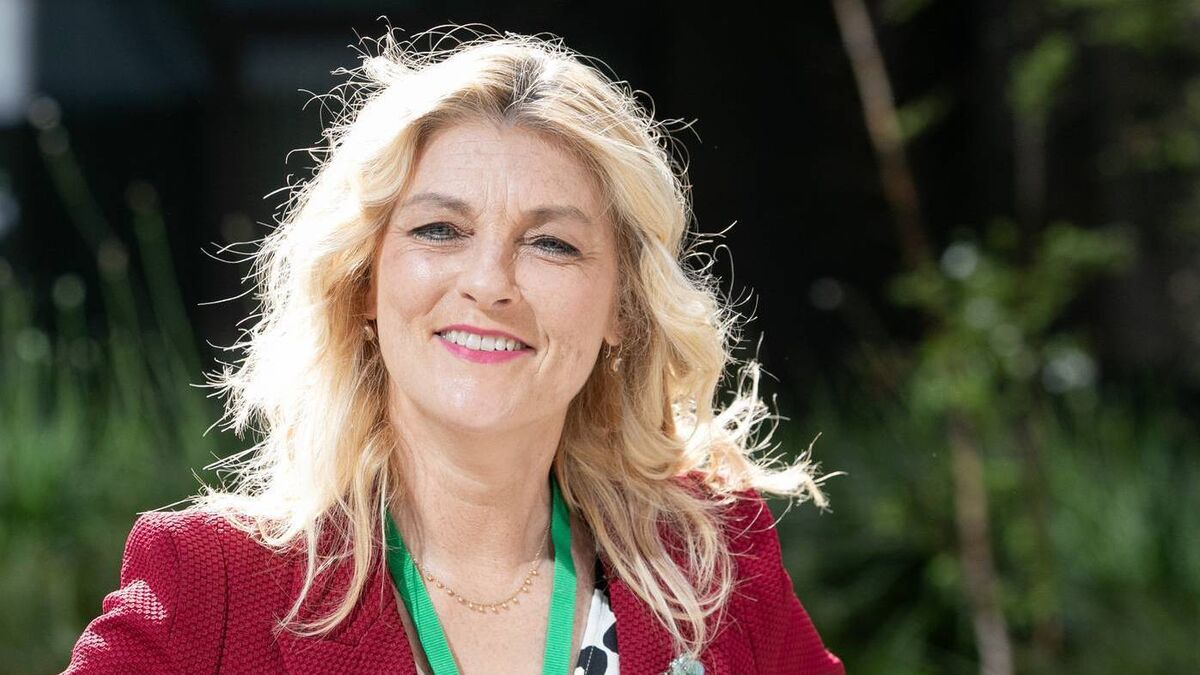
In the layered machinery of the European Parliament, where compromise is currency and consensus is hard-won, Cynthia Ní Mhurchú has built a career on something more personal: the disciplined power of her voice. In Brussels, a city of quiet negotiations and careful language, Ní Mhurchú’s politics begins not with procedure, but with dialogue.
In an interview with The College Tribune, Ní Mhurchú reflects on a career that has moved from media to law to politics, united by an instinct driven more by experience than ambition. “Some people don’t have a voice,” she notes, “and I’ve always felt a great interest in helping people in that regard.” For the Ireland-South MEP, the challenge is not simply to speak, but to ensure others are heard.
Her route into European politics was anything but conventional. With a background spanning education, journalism, and the law, Ní Mhurchú frames her career around advocacy, an instinct that has carried her through her professional life. Communication, she suggests, is not just a skill, but a responsibility: “I’ve always felt a great interest in helping people.”
Such emphasis on dialogue shapes her understanding of the European Union at a time of strained political cohesion. “Europe is much more than economic unity,” she says. “It is a space of values and of ideas.” Drawing on its post-war origins, she describes the EU as a “peace project”, grounded in the rule of law and democratic cooperation. “Unity in Europe is more important than ever,” she adds, while acknowledging that unity does not often equate to uniformity.
If Brussels runs on anything, she suggests, it is compromise – often slow, frequently frustrating, but ultimately necessary. Representing 27 member states requires constant negotiation, and Ní Mhurchú emphasises her rejection of the politics of “bickering”, stating, “It’s very important to be respectful, reflective, and actively listening.”
The MEP’s legal background has shaped that approach. Describing herself as “very much a mediator, a negotiator, a collaborator,” she recognises the tensions between ideological differences and practical governance. “It’s not always easy… when you have different viewpoints coming at you.”
Questions of identity remain central to her work, particularly the place of the Irish language in European institutions. “Language should never be used as a political badge,” claims Ms Ní Mhurchú. “It is part of our cultural identity… part of our DNA.” She continues to push for the enhanced inclusion of Irish in EU institutions, targeting the removal of the current language derogation on Irish, which runs until 2029.
It is in trade policy, however, that the balance between principle and pragmatism becomes most pronounced. Ní Mhurchú has been an outspoken critic of the EU-Mercosur agreement, which seeks to deepen trade ties between the EU and the South American Mercosur Trade bloc. Her opposition, she relays, centres on standards, particularly when it relates to agriculture: “I opposed the Mercosur deal due to its impact on the beef sector,” she stated. “We have one set of standards for our farmers… and another for imports.”
Critical of double standards within EU policy and the handling of the deal by President Ursula von der Leyen, she recognises the economic pressures but seeks reconciliation between short-term economics and long-term standards.
Speaking on this, she said, “If we sacrifice standards on the altar of economics, where do we stop?… I am very unhappy with the recent actions of Ursula von der Leyen.” Expressing frustration with the handling of the agreement at the Commission level, she questions the “Respect there is for parliamentarians” from the President of the Commission.
At the same time, Ní Mhurchú concedes the legitimacy of opposing views from her Irish European colleagues, such as Barry Andrews and Regina Doherty: “I understand why others support it. I do want businesses to thrive and survive… Normally I would be 110% voting for a trade agreement, but we have to have standards”, she explained.
When pressed on the issue of media distortion of the Mercosur debate, she points to the imbalance in how it has been publicly represented. “The IFA [Irish Farmers’ Association] and other farming groups are very good at advocating… they would have been available to counter those arguments if there had been open debates, but there simply wasn’t.”
For Ní Mhurchú, the challenges of European political life extend beyond policy, encompassing the tone and conduct of debate itself. In December 2025, Polish MEP Jacek Ozdoba made audible “pig-snorting” noises while Ní Mhurchú spoke in a committee meeting. “It was misogynistic… and it was disrespectful,” she says. “I couldn’t let it go.” After filing a formal complaint, she underscores the importance of calling out such behaviour: “We cannot have that in a democratic parliament. I think of all the young female politicians out there, and the young male politicians as well… who wouldn’t be able to stand up.”
Looking ahead, Ní Mhurchú identifies the upcoming Irish EU Presidency as a unique chance to establish and resolve Union and Irish priorities. She hopes the focus can be directed towards vital issues for Irish voters, such as Medtech delays and digital protection for children. “It’s taking years to approve devices that take months elsewhere,” she says, while stressing the “need to be protected” for children online.
She also expressed concern around youth disengagement from politics. She highlighted that “Young people traditionally don’t vote… They feel left out.” She hopes the Irish Presidency can engage young people with issues facing Irish and European society and believes the Irish language can be a critical tool for engagement. She emphasises the need to rebuild trust and “get closer” to younger people, highlighting their vitality to the politics of the EU and the world.
Ní Mhurchú’s vision of Europe rests on a simple but demanding premise: that dialogue and standards can reinforce rather than undermine one another. At a moment when European institutions are often criticised for their distance from the people they serve, her focus is on narrowing that gap; not through grand gestures, as she suggests, but through an insistence on accountability. Whether that approach can reshape how the Union is perceived remains an open question. Yet, it gestures towards a broader truth about political life in Europe: that representation is not merely about speaking for others, but about making a space for them to be heard.
Harry O’Leary – Contributor