

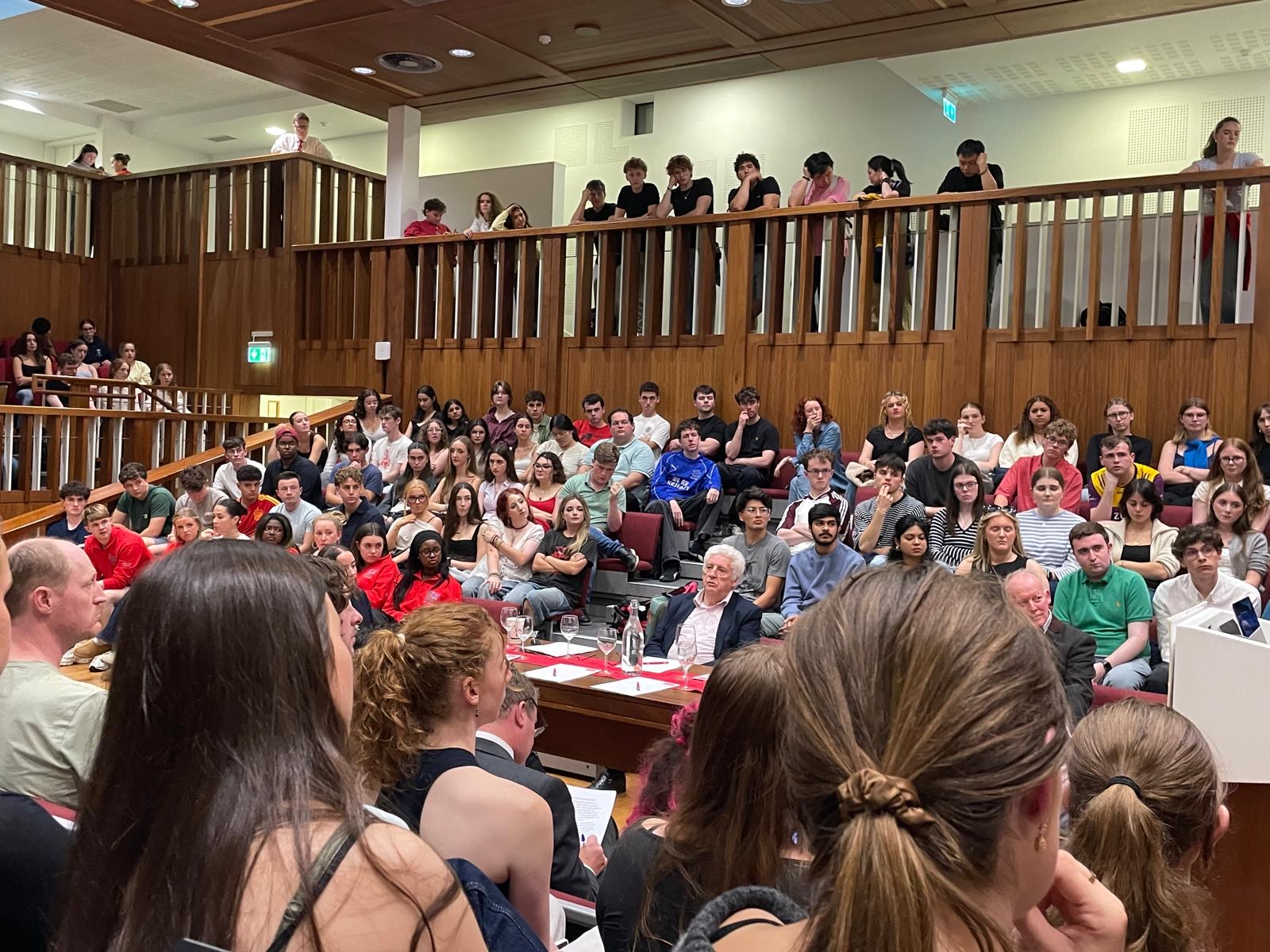
Thursday, the 22nd of September, the UCD Law Society held a debate on the motion titled ‘This House Would Fight for a United Ireland’. A Northern Ireland motion has been a long staple in UCD debating, and the Fitzgerald Chamber was packed for the lively debate, with only standing room available as the house voted overwhelmingly to pass the motion.
Former SDLP leader Alasdair McDonnell opened the debate by sharing his personal experience of growing up in Northern Ireland. He paid tribute to those who worked on the Good Friday Agreement, particularly John Hume and David Trimble and declared that “we need to decide if we want to fight to make this a better island.” He further argued that ‘both sides have suffered from partition,’ describing it as a “temporary arrangement that became permanent.”
Professor John Fitzgerald opened the opposition’s arguments, introducing a plethora of statistics and references to studies to support his argument that reunification would harm the Irish economy. Pointing to the reunification of Germany, he said that prices in Northern Ireland would adjust immediately, wages would need to follow, and this could create short-term job losses. He stated that in offsetting the subsidisation of the Northern Ireland budget that had been covered by London, “the people of the Republic will see a bigger shock than the financial crisis.”
Fianna Fáil Galway county councillor Cillian Keane emphasised a point echoed by all proposition speakers: that fighting for a united Ireland did not mean a call for violence or force, but rather a political fight through democratic processes. He declined to clearly map what a united Ireland would look like (or even to sketch one as an audience member requested), instead contending that there are “endless possibilities for change in this state.”
“That road is walked. It’s led to grief and pain, and what I’m fighting for is a united Ireland delivered constitutionally through mechanisms such as the Good Friday Agreement, which provides for consent,” he says. “Now, one issue that leads to the ambiguity is the fact that the Northern Irish Secretary won’t actually determine or give us a definition of what a majority is, but that’s not an issue in terms of arguing for a united Ireland; that’s just a way of avoiding the question, in my opinion. If the majority of this island wants it, well then it should get it, and that’s not a threat; that’s democracy.”
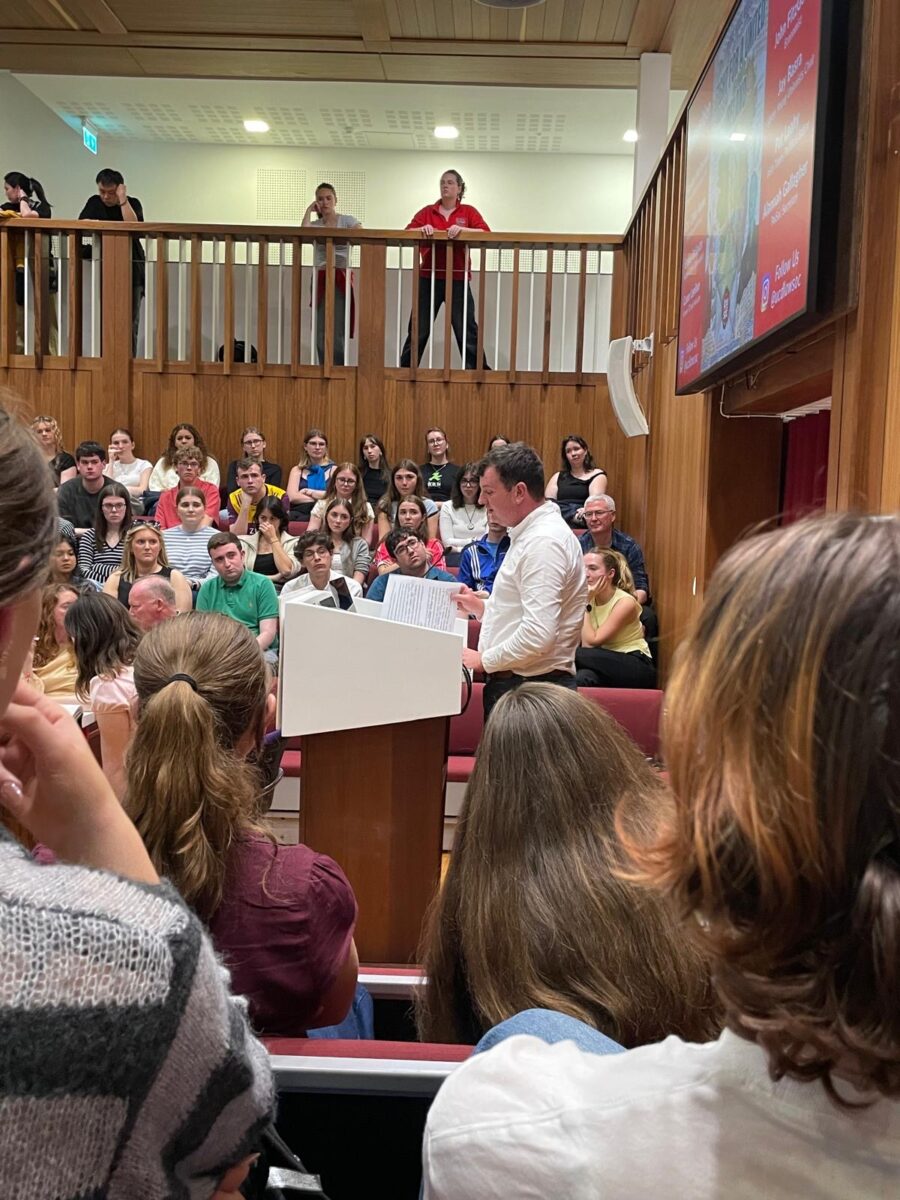
Speaking second for the opposition was Jay Basra, chairperson of the Ulster Young Unionists. He began his speech by questioning the nationalists in the room on why they support reunification, warning that it “might stir your national pride but it won’t cut it for unionists.”
When an audience member asked whether young people in Northern Ireland were being left behind by the United Kingdom, the UUP youth wing chair stated he was “not the best person to answer that.” He closed his speech with an acknowledgement of the problems that unionism faces in Northern Ireland, describing “ apathy with leadership who have expected votes” from unionists. He argued that while unionism “does need to listen to its people”, ultimately “people in Northern Ireland love the country and want to remain in the union.”
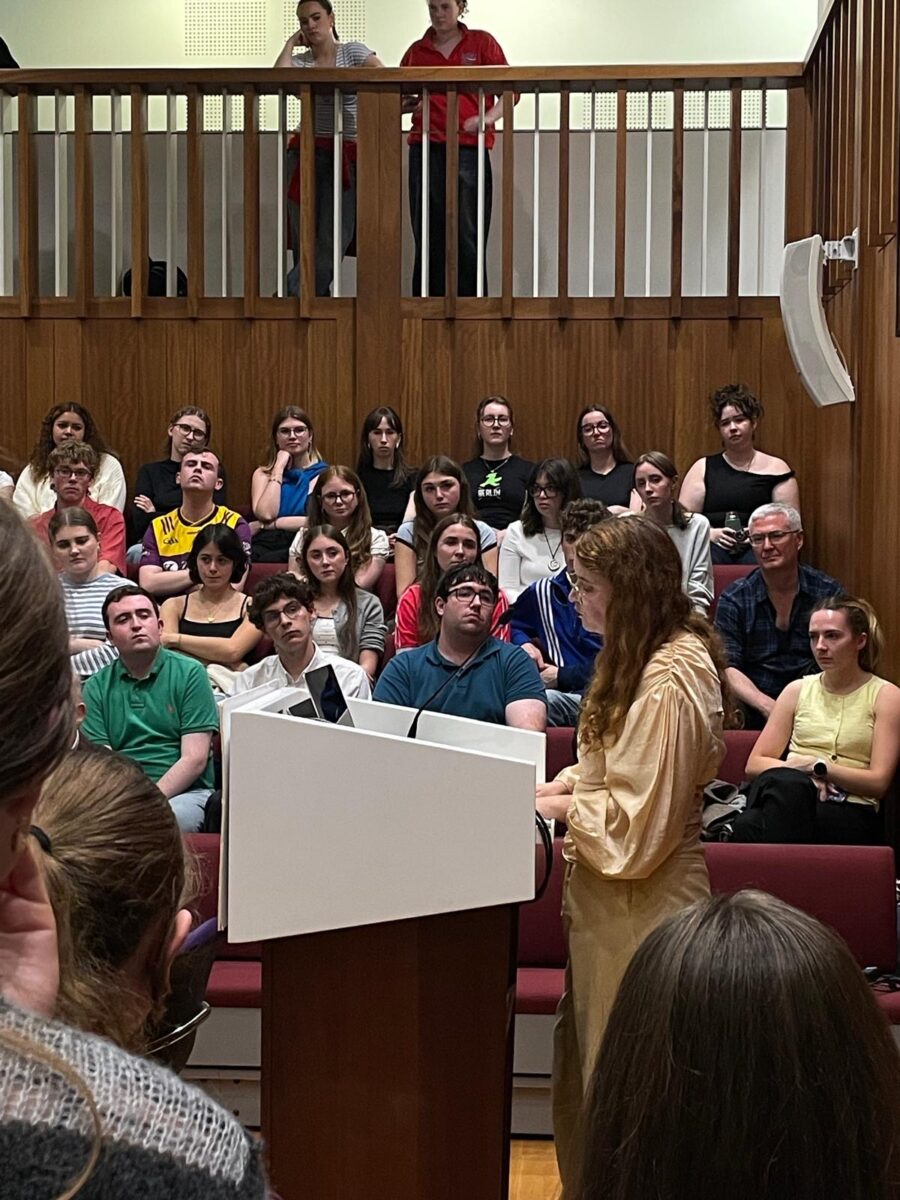
Journalist and human rights activist Emma DeSouza spoke next. She criticised the economic narrative that Northern Ireland is “deadweight,” and what she described as a “reduction of 2 million people to an accountancy exercise.”
“And yes, John, we do have to talk about money. John Fitzgerald and I disagree about the cost of unity, but I am interested in how this question is framed,” she said. “Why does Northern Ireland so often enter this debate as a liability? What will they cost us? Almost two million people reduced to an accounting exercise. It is very easy to ask what Northern Ireland will cost when you have never been the person being costed. So, by all. Northern Ireland has an economic inactivity of about 25 %, which means around 25 per cent of the population do not even want to enter into employment.”
“I would fight for a united Ireland, but more importantly, more fundamentally, I fight for a right to decide, a right to demand more and a right to build something better than what we inherited. That is a future worth fighting for.”
Irish Times Political Editor Pat Leahy, after going on about the ‘old farts’ that come back to UCD, continued the economic arguments for the opposition, stating that those who advocated for a United Ireland “need to stop pretending the costs won’t be an issue.” He noted Donald Trump’s recent trip to Ireland, saying “he shared with his hosts that he wanted to see a united Ireland, which he said would be a beautiful thing. This was to the consternation of Micheál Martin, who looked like someone had farted at Mass.”
He also put the question to the house: “How British are you prepared to be?” He suggested that a united Ireland, which would absorb a unionist population, would be more British than it is now, and that questions need to be asked about the national flag and anthems, and about membership of the Commonwealth and NATO.
Closing the proposition argument was Conor Lenihan, Former Fianna Fáil Minister for State. To much applause, Lenihan described Northern Ireland as an “artificial state, artificially created and artificially sustained.” He also stated that “The British establishment has no time for Northern Ireland anymore.”
UCD Student Allanah Gallagher closed the debate, noting how she has “never known an Ireland at war and doesn’t want to.” She questioned the worth of ‘fighting for a United Ireland ‘, claiming “I will not force people to be part of a country that they do not want to be a part of.”
During the final few minutes of the debate, an audience member asked the speakers, “Should we unite Ireland to close our borders?” Lenihan gave an unclear answer, stating that while he was not against immigration and emphasised Ireland’s place in the European Union, he would like to tighten borders to not let in ‘illegal asylum seekers, coming from Britain’. He finished his statement by saying, “Yes, a united Ireland would help in controlling immigration. I’m not saying I’m anti-immigration, but illegal immigration has to be policed and our jurisdiction has to be protected.”
Aisling Murphy & Sophie Gliott – Co-Editors