

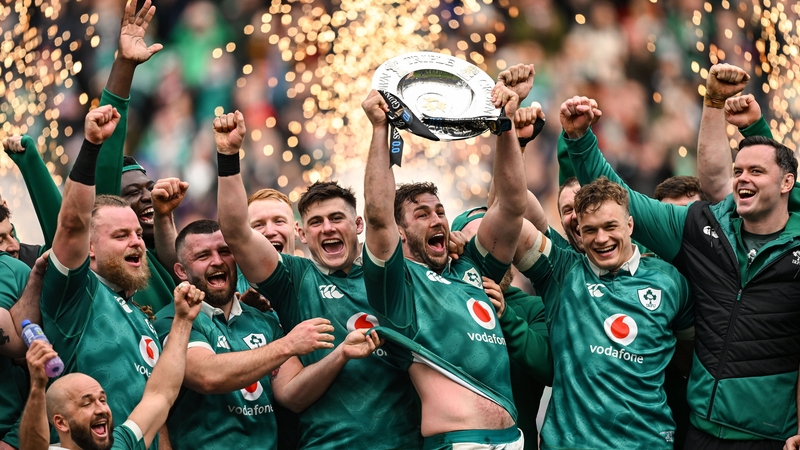
Following Ireland’s decisive defeat to France at the Stade de France, few would have guessed that Andy Farrell’s side would be entering the last weekend of the Six Nations Championship vying against Les Bleus for first place in this year’s tournament. A besieged England side in the race for the wooden spoon with Wales and Italy would not have been predicted by the English press, who had generated much hype around the depth of talent in the ranks of Steve Borthwick’s side.
With expectations well and truly defied, Ireland, Scotland and France all came into the final day of action with palpable, realistic paths to the Six Nations title.
Ireland v Scotland:
Ireland versus Scotland has come to be viewed as one of the classic fixtures of the Six Nations in recent years, and this year there was a lot more at stake than usual. Following victories against Wales and England, both sides stood poised to clinch the Triple Crown with a victory at the Aviva. Scotland’s shock victory against France had blown the title race wide open. If results went either way in the Stade de France victory, Dublin could also secure the Six Nations’ title. Following Ireland’s opening-round decimation at the hands of Les Bleus and Scotland’s opening defeat to Italy, neither side had expected to be within touching distance of first place, and as such, there was a great degree of anticipation and hope surrounding this game.
Ireland drew first blood when Jamie Osbourne opened the scoring, breaking through the Scottish line and grounding the ball beneath the posts. Jack Crowley continued his run of good form and converted to give Ireland a 7-0 lead. This opening try proved vital, as minutes later, after a gruelling nineteen phases, Darcy Graham put Scotland on the scoreboard. Scottish stalwart Finn Russel showed great precision to convert from a tough angle.
Ireland’s response followed soon as Dan Sheehan broke the deadlock, crashing over the Scottish line following a maul. Crowley once again converted, placing Ireland firmly in the lead. Perhaps the most impressive score of the day was yet to come; Ulster winger Robert Baloucoune withstood outstanding Scottish pressure by simultaneously grounding the ball over the Scottish line and avoiding being dragged into touch. Ireland emerged from an intense first-half clash with a lead of 19-7.
Scotland, however, was not going to relinquish its push for the Triple Crown without a fight. Finn Russel breached the Irish line and duly converted his own try to put Scotland within five points of Ireland. It was at this crucial juncture that Darragh Murray, who had come on as a blood sub for Tadhg Beirne, secured a crucial fourth try for Ireland. Murray’s try, which ensured a dream debut for the Connacht player, was followed up with a conversion. A Gilchrist try and a Russell conversion pinned Ireland back to a five-point lead. Leinster winger Tommy O’Brien was to seal Ireland’s victory with two impressive tries. The game finished with an Irish victory, 43-21. Andy Farrell’s side had secured the Triple Crown; all eyes now turned to Paris in the hope that Borthwick’s embattled England side could do Ireland a considerable favour.
Wales v Italy:
While Wales’ lacklustre Six Nations performance had not come as much of a surprise, the meteoric rise of Italy had taken many by surprise. It was widely expected that Gonzalo Quesada’s side would languish in a familiar sixth-place position when this year’s championship had concluded. Through their outstanding performance in this year’s tournament, critics of the Italian team had found themselves momentarily silenced. A shock win against Scotland in the first round had demonstrated that Italy were intent on leaving its mark on the Six Nations. Italy, in fact, came into this final-round clash with Wales, fresh from a stunning victory against England. Wales, on the other hand,d had, up to this point, had a Six Nations to forget as they came into this game following a lacklustre performance against Ireland in the Aviva Stadium.
Wales struck first in front of an ecstatic home crowd as Wainwright crashed over the Italian line and electrified the Principality Stadium. Edwards duly converted, giving Wales a 7-0 lead. Wainwright was to cement the Welsh lead in the 25th minute, grounding the ball over the whitewash following an intense maul. Edwards once again showed laser precision from the tee, slotting the ball between the posts to secure a 14-0 lead for Wales. Wales capped off this purple patch with an uplifting try from Welsh captain Dewi Lake. Following Edwards’ conversion from the Welsh skipper’s try, the home fans began to believe Wales would finally break their unenviable streak of fifteen games without a win.
Wales began the second half with a twenty-one-point lead as Italy had yet to make an impression on the scoreboard. Wales’ victory was all but sealed as Edwards scored a decisive try just three minutes into the second half. Edwards, who had proved consistently reliable off the kicking tee, proved able to convert from his own try, giving Wales a commanding lead of 28-0. Edwards followed up his own try and conversion with a drop goal to increase Wales’ advantage to an imperious 31 points.
The commanding lead Wales established was to prove vital in withstanding a late Italian rally. In the 51st minute, Di Bartolomeo opened the scoring for Italy; a conversion from Garbisi quickly followed this try. Italy were to score another try on the 68th minute as Allen crossed the Welsh try line. Although Garbisi failed to convert, this try was enough to place Wales on high alert and remind the home support that the game was not yet through. Wales held firm, and despite conceding a try in the 80th minute, they had done enough to hold off the late Italian rally. Wales had secured their first Six Nations victory in three years following a solid performance on a convincing score line of 31-17. Despite their impressive finish to this year’s tournament, Wales found themselves rooted to the bottom of the table as they finished in sixth place. Although this was not the finish to this year’s championship Italy wanted, they secured fourth place, finishing ahead of both England and Wales.
France v England:
At the beginning of the Six Nations Championship, many had tipped the final-round clash between France and England to be the game that would decide the championship. Although this game would ultimately decide the championship, it did not end as many had predicted. Most had predicted that England and France would both be vying for victory and that this clash would be the one to separate the two sides. England’s disappointing campaign left them firmly out of contention, but Les Bleus were still in need of a victory to prevent Ireland from clinching the title on the last day.
A Ramos conversion following a try from the in-form Louis Bielle-Biarrey electrified the home crowd at the Stade de France as home fans in Paris felt one hand on the Six Nations’ trophy. England had no intention of going down without a fight and responded with a Roebuck try. Smith’s inconsistency from the kicking tee would mar England’s performance on the night, and his failure to convert gave France a slender two-point lead. Another Bielle-Biarrey try, and Ramos conversion reasserted the home side’s lead. A handling error from Attissogbe allowed Murley to ground the ball in the corner for another unconverted try for England. Ramos was to maintain France’s lead soon after as his kick from the tee gave France a 17-10 lead. Chessum was soon to close the gap between the sides with a duly converted try. Chessum was to be instrumental in setting up Coles for a vital try converted by a Marcus Smith drop goal. Smith put an impressive gloss on the half-time scoreline with a penalty, giving England a ten-point lead against the hosts. The home crowd in Paris were silenced as Ireland dared to dream of what had seemed an unlikely Six Nations title. Les Bleus were soon to reassert themselves with a penalty try with the clock in the red.
It seemed France had well and truly realised what was at stake as Bielle Biarrey scored a third try to earn his hat trick and put France four points ahead. Antoine Dupont was soon to set up Attissogbe for a crucial try, which the ever-reliable Ramos duly converted. Chessum crossed the French line once again; although Smith failed to convert, the French lead was narrowed to six points. Smith subsequently went over and converted his own try in the 50th minute to restore England’s lead. In a breathtaking second half,f Bielle Biarrey scored another converted try to restore the home side’s lead. It looked as if England had secured the Six Nations title as a Freeman try gave England a one-point lead with a mere ten minutes remaining. Yet both Irish and English hearts were to be broken as a late Ramos penalty secured the Six Nations title for Les Bleus.
This whirlwind clash ended on a scoreline of 48-46, although Irish hopes were dashed, few could dispute that France were deserving victors in what has been one of the most exhilarating and dramatic Six Nations of recent years.
Darragh Sinnott – Contributor