

Universities today promote themselves as ideal environments for personal growth and discovering identity, promising to prepare students seamlessly for society. For many, a good college experience is measured through the different aspects of university that shape their lives. These things include education, social life, and everyday opportunities found around campus. Some students, however, feel that the institution’s pushback against student-led experiences has limited their hopes for university life. Why then is there such a disconnect among UCD students about whether these promises are being lived up to?
Students’ everyday lives are shaped by this idea of time and freedom. For some, their time on campus can be social due to their financial flexibility and ability to live on campus. However, for lots of students, neither circumstance applies. Spontaneous plans, or even plans that are too late into the night or during an inconvenient time of day, aren’t accessible to students who live off-campus or must work to get themselves through school. All students want a good college experience (regardless of their definition of it), but many simply don’t get the opportunity.
One way many students express themselves and develop their characters is through societies. There is a wide range of societies, over 80 officially recognised by UCD, with the most popular ranging from Film and Dance to Law and Mathematics. Yet, societies don’t seem to be all they make themselves out to be, often hosting either low-turnout events with minimal member participation, or high-turnout events that don’t offer enough for everyone. A student outside of a society event told The College Tribune: “If you’re not going with someone, it’s not even worth it to go. They’re never advertised correctly either” and “There’s never enough food for everyone, and I never meet anyone new”. But the difficulties of meeting people through societies and their events aren’t felt by everyone. Committee members of the Film Society claim to have turnouts of between 10 and 70 at their weekly events, which are valuable social opportunities. At smaller events, people have the opportunity for full-group discussions; with greater turnout, students form smaller groups to discuss. “Most societies try very hard to make all their members feel included and welcomed,” a student said.
What about creativity and the possibility to express oneself around campus? Hypothetically, there is always room for students to express themselves through different media, including through posters around campus. One might think they could display their artwork or an invitation to an informal get-together anywhere around campus. Still, the truth is that there are strict rules about when and where certain posters can be put up, with Estates Services cracking down on posters that don’t originate from societies or any poster with political messaging.
“Getting up our poster for Drama Society wasn’t easy. The guy running it couldn’t put them up himself because they had to be put up by a certain time in the morning and he lives off campus, so I had to do it,” said a student putting up posters in the early morning. There is a difficult-to-manage process to postering, including having to have them up by a certain time in the morning and having affiliations with a society or the university. Around UCD, there are dozens of indoor and outdoor open spaces. Yet, there never seem to be too many posters in different buildings; there are clear signs discouraging students and stating, “All posters will be removed from this area”.
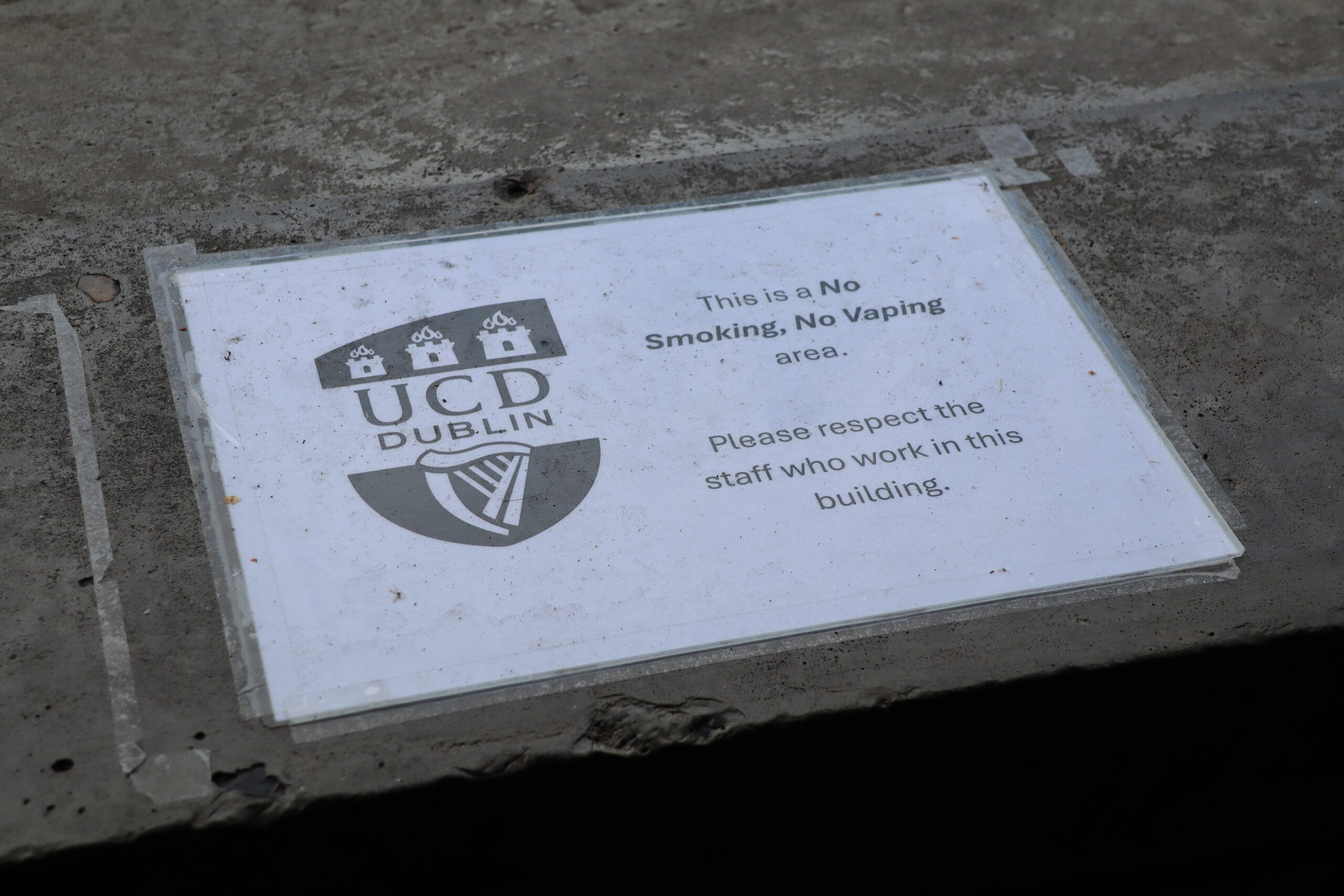
Some students feel the university’s control over their freedom of expression extends to their everyday habits. Recently, UCD has increased the number of anti-smoking signs. One student reports being told to put their cigarette out during a time of high foot traffic outside of Newman, while an anonymous poster on the UCD Confessions Instagram page pushed to “take back control and take back our Newman smoking area”.
Yet, you see people breaking these rules. The higher anti-smoking signage has done little to stop anyone, with several students reporting that they haven’t faced any trouble so long as they’re not in the way. “As long as you’re not in people’s faces, it’s not bad. I really just don’t think people care enough,” said one student.
The same “out of sight, out of mind” pattern seems to work within the rules of student residences. To be exact, the guest rules. “My roommate has people over all the time; I don’t find an issue with it so long as he tells me first, and honestly I do the same,” said one student. The rules, detailed by UCD, require students to complete online request forms to have guests stay overnight, thereby limiting their autonomy. Stories of estate workers barging into dorms requesting to ‘check’ noise and possible partying have also circulated on campus.
Campus culture is becoming increasingly sanitised. Students don’t have the same autonomy that they have had in previous years. Young people are meant to use this time for self-exploration and rebellion, but the rules in place keep students firmly in their lanes, with little ability to find themselves in other ways. Only those with the time and freedom to explore get the privilege of living their time here as a “true college student”. For students, it matters to remember that your experiences are shaped by what you spend your time on and by the hardships you work around to do so. University should be one of the few environments where young people feel encouraged to challenge authority, question institutions and experiment with ideas, rather than simply conforming to expectations.
By Mo Pannier