

A battered Toyota six-seater struggles up a narrow mountain road, swerving haphazardly to dodge oncoming traffic. Stuffed into one of the backseats, I avoid looking at the sheer cliff to my left, surrendering all notions of agnosticism and praying silently to whatever saint is in charge of Bosnian driving. Žika, the multi-hyphenate driver – tour guide, hostel owner and former Yugoslavian war refugee – uses this opportunity to educate us on the city’s history.
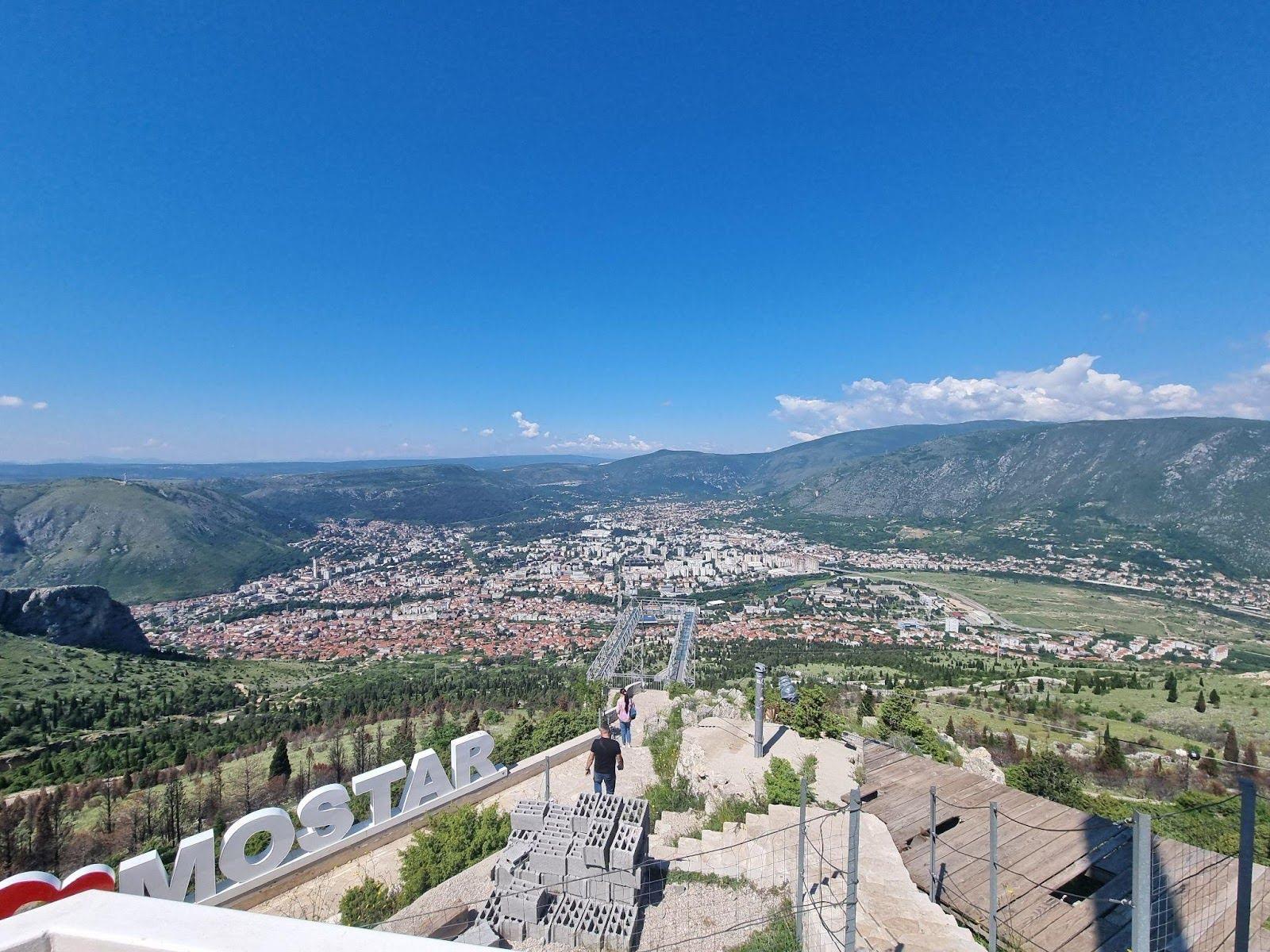
We’re on our way up Fortica hill, the iconic tourist view and Mostar sign await. His house, which also happened to be our hostel, was a munitions factory during the Yugoslavian war – A grenade had blown up in the kitchen where we ate breakfast that morning. As we reach the top of the hill, the city of Mostar expands before us, and he explains the divisions that have defined his life. He points out a road just past the river that snakes through the town, with the east side being where Bosnian Croats live and the west side being where he and the rest of the Bosniak Muslims reside. He tells us that despite having lived in Mostar the majority of his life, he knows very few Bosnian Croats, and decidedly isn’t friends with any of them. He warns us against going off the trails if we’re hiking in the hills, as there are unexploded landmines dotted around the Bosnian countryside. I find this to be a poignant metaphor for the political tensions that lie within the region.

I spent the month of May travelling the Balkans; my journey started in Dubrovnik, Croatia, then continued through Bosnia and Montenegro before reaching the end in Albania. My tour of locations surrounding the Bosnian city of Mostar served as a microcosm for my experiences throughout the Balkans. It was a spontaneously organised trip – so much so that even associating it with the word organised feels wrong – and one I entered without strong preconceptions of the places I was to visit. The Yugoslavian wars are still fresh in the minds of older generations, especially for my mother, who was initially very confused as to why I would want to visit that part of the world. Having been born years and miles away from the conflict, for me, these countries lacked the negative historical connotations. I came for eye-catching views I’d seen in photos online, affordable hostels, and the chance to experience new cultures.
Because I was a solo traveller, everyone in my Mostar tour group was a relative stranger to me. There were four of us: an English-Norwegian girl, an English-Iranian man, and the Scottish-Malaysian fellow whom I met the night before – all in our early twenties, all born after the Yugoslav wars. The irony of exploring the divisions in a foreign society alongside a group of British people wasn’t lost on any of us, and a cloud of uncertainty around how to discuss the subject with each other lay heavily over our platitude-filled interactions.
Upon arriving, I found the histories of the ex-Yugoslav locations to be almost unavoidable, even with my prior ignorance of them. I went hiking up Mount Srđ on my first day in Dubrovnik, looking forward to an especially beautiful sunset vista. On my way up, I was told about the Yugoslav People’s Army, which used the hill to bomb the city below during the The Croatian Independence War in 1991. As with the landmines in Mostar’s hills, the natural beauty and political tensions of that part of the world seemed inextricably linked. Everywhere seemed to be coloured by events of the war.
As an Irishman, it was easy to draw comparisons with issues that still exist in the north. Both societies are trying to navigate the physical and metaphorical landmines that exist in their daily lives. My tour guide, as well as any other locals I met, always insisted in our conversations that Mostar and the Balkans as a whole had many great things to offer aside from war and historical tourism. They seek to rebrand their countries as the beacons of natural beauty and culture that they are today, instead of the war-torn states they once were.
Our three destinations that day reflected that progression, even if two of them were linked to the war in some way. Fortica Hill, for instance, had a glass observation deck with excellent views of the city, a large zipline and a Hollywood-esque Mostar sign; features starkly distinguishing it from any prior wartime associations.
Our next stop was an abandoned Yugoslavian military base near Mostar. If you venture past a gate, down a deserted-looking road across from the small-town airport, you’ll find the entrance to the underground hangar. Our driver described it as his secret spot, where few other tourists had ever explored. Once a significant investment in an attempt to bolster Yugoslavia’s military, it now lies barren and empty, aside from the odd beer can and cigarette butt. Our guide informs us that some of the locals hosted rave parties there in the past. Phone torches on, my tour group explored empty dormitory rooms and massive hangars. I couldn’t help but feel that the transformation from military installation to party spot might represent a hopeful reality in this previously war-torn state, a way that the younger generation expresses their ‘coming to terms’ with what is a painful history.

Our final stop of the tour was at the Kravice waterfalls in Bosnia and Herzegovina, a particularly scenic tourist destination, wholly divorced from any associations with war. Our guide assured me that its pools had the coldest waters in all of Europe. Having swum there and in the Irish Sea, I’m still convinced that the Irish water is colder. Although the group of Italian tourists I saw swiftly putting their clothes back on after venturing ankle-deep may disagree.
After swimming, I spent an hour or so talking with the rest of my tour group at a cafe with a view of the waterfall. Any awkwardness that had existed between us at the beginning of the day had vanished. Surrounded by chattering tourists and overpriced lattes, I felt the warmth I had lost while in the water spreading through my veins. It was easy to forget that there had ever been a war.

Months later, I attended the literature, politics and arts programme at the John Hewitt International Summer School in Armagh. Takura Donald Makoni, Policy Director of the African and Caribbean Support Organisation Northern Ireland (ACSONI), gave a talk. He explored the meaning of ‘integration’ to government, communities, and specifically what it means in a post-troubles society. He told the audience that all human beings are similar and will naturally connect if not influenced against doing so by external forces, later specifying that said outside sources were generally politicians.
Listening to the talk, I thought of my time in Mostar, and the cafe by the waterfall. I am as certain now as I was then that if societies, unburdened by the weight of The Troubles and the Yugoslavian Wars, truly exist in our futures, then we will find them through human connection.

Garvan Ó Deaghaidh – Contributor