

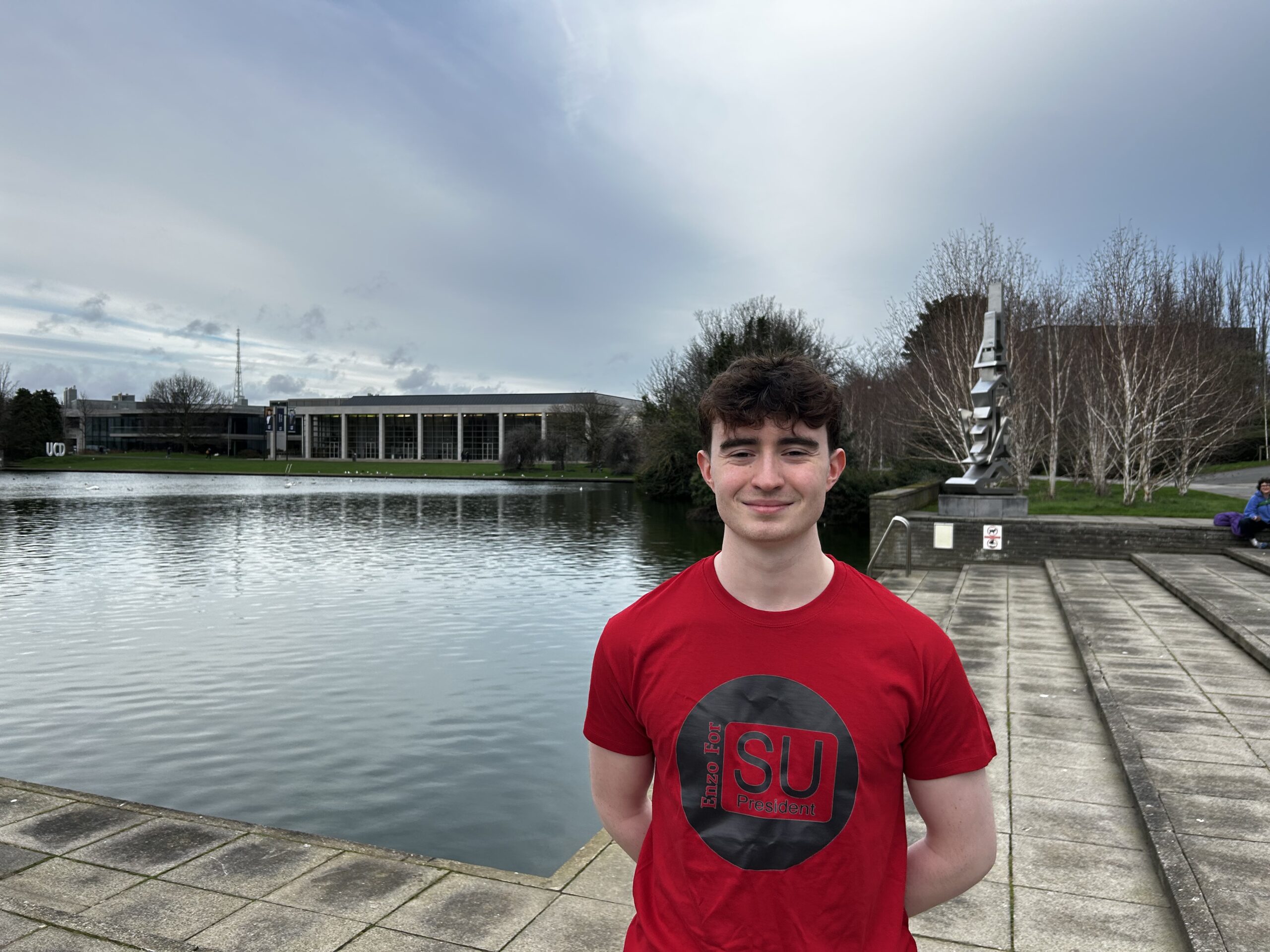
Enzo Crothers is a Stage 3 History and Politics student. He is running uncontested for the role of UCDSU President. He has previous experience both on and off campus that he believes would benefit him greatly in the role of president.
He was a committee member for both the History Society and the Politics and International Relations Society. He also has a year of experience working as a debate convenor for the L&H Society. Outside of UCD, he has been involved with various political campaigns, including the UCD Boycott, Divestment, Sanctions (BDS) encampment in 2024 and the “vote yes to USI” (Union of Students in Ireland) referendum last year.
The College Tribune asked Crothers what he thinks his uncontested race says about student engagement with the SU. He explained that when he originally put his name down, he had been told that there were five others interested in running, and he “Find[s] it very interesting that it’s no longer contested”. He also said that he finds it disappointing that he is the only candidate running for the role. Outlining that, aside from making hustings “a lot more fun and dynamic,” a contested race would have also been positive for the health of the union.
He highlighted that the lack of choice in the presidential race, as well as the four vacant College Officer roles, is “Really poor to see”. This is something he ultimately hopes “to improve on during my tenure, if I’m elected”.
A cornerstone of Crothers’ campaign is his hope to collaborate closely with AMLÉ (formerly USI). When asked what campaigns or policies he plans to prioritise going into this relationship, he explained that it would be “UCD-driven policies,” highlighting his hopes of utilising the UCD voices within AMLÉ. He referenced AMLÉ’s national conference, on which UCD has 36 delegates, further explaining, “We have a massive voting block there and a lot of power … we have a lot of influence … I want to make sure that we’re using that to the maximum”.
He plans to focus mainly on national issues, such as affordability, with AMLÉ. Speaking on previous Sabbatical team’s failed campaigns to combat affordability issues, Crothers said, “The reason, in my opinion, why it has failed is because there hasn’t been this national outlook for a national issue”. He further emphasised that change will not “Be achieved through one student union, but it can through a unified one”.
Another focal point of Crothers’ manifesto is political activism. When asked what he would say to those who believe the SU should be apolitical, Crothers replied, “The Union is political by nature. You’re talking about a unified way of collectivising voices, which is always going to be political, in my opinion”.
***Referencing the council’s decision not to endorse Catherine Connolly, he explained that he absolutely supports the fact that people had their say (Crothers worked on Connolly’s campaign) “It’s a democratic decision at the end of the day. And as president, it’s your job to represent people”.
One of Crothers’ plans if elected is to host regular club nights for students. When questioned about the affordability of these nights, he explained his aim to ensure he at least matches current club night prices or even lowers them. He believes “A great thing can be done then, with the divvying up of profits, we can either reinvest that back into the union, and you could see that with affordability drives here on campus … or we could donate that money as well to other causes”. Crothers also hopes to collaborate with the next Entertainments Officer to deliver a range of events for students to enjoy.
Answering how much revenue he expects these events to generate, he explained that this will depend on who the SU is collaborating with regarding the venue and the type of artists and talent booked for the event.
“The main focus on this isn’t going to be profit, it is going to be winning that PR war with students and making the union seem competent and able to put on good events that people are actually engaged with. You know, if you’re able to do that, you’re able to translate that into things like political activism”, he further emphasised.
When probed further on the allocation of potential revenue, he said that, if president, he would have some say in this, ultimately “It’s not all up to me. There’s obviously various financial committees that has to go through”.
The College Tribune asked Crothers whether he has researched the potential cost of these club nights. He highlighted that he had and explained how his background in societies will serve him as he has organised events like this in the past. He mentioned how some of these events have “brought in quite a significant amount of revenue”. He hopes to foster collaborations between the union and other societies and believes these collaborations will mitigate any financial risks arising from low ticket sales. He believes low turnout for SU events in years prior is due to “poor marketing of the events, and a general lack of understanding of what students are looking for, which is something societies are really good at doing”.
Speaking about his plans to collaboratewith AMLÉ to improve affordability for students on a national level, he hopes to work on “getting that reduction in fees that we were promised by the two government parties at the moment.” He claims the €500 fee increase is a “kick in the teeth to a lot of families and a lot of students who are financing their way through college themselves.” He mentioned his disappointment when “we didn’t have more of a national uproar about that through the various student union bodies”.
Asked how he hopes to improve on-campus affordability, Crothers referenced a few ideas he gathered from “purely speaking to different students and then members of Council on what we believe might be feasible”. These include “better commuter breakfast, an expansion of exam dinners, and then potentially, depending on how much revenue we’re bringing in, some form of subsidies within the SU shops”.
Crothers acknowledged that these policies had been advocated for in the past. Still, he believes that they “failed because there wasn’t a good understanding of the way the funds are broken up within the union, and through bringing in increased sources of revenue, I think that opens up greater opportunities”.
In his manifesto, Crothers calls for a continued relationship with international solidarity groups. Elaborating on how this would look in practice, he explained that next year, when the SU is running international-related campaigns with the wider council, he hopes to include experts. “If we’re talking about Palestine, for example, having BDS in consultation is great to have. And then Amnesty International, if we want to talk about wider issues”. He plans for a consultative period and emphasised that “these people are the experts … I think it’s very important that their voice is heard within the union.”
Asked to outline the specific supports Crothers has planned for LGBTQIA+ students, he explained that he hopes to work with Transgress if elected. He also highlighted his hope to increase awareness of the union’s dedicated fund for gender-affirming care.
Another goal in Crothers’ manifesto was to ensure UCD cover the cost of the exam shuttle bus. Since this was already paid by UCD this year, Crothers explained that “no one seems to be able to agree” on whether UCD will continue this. He is hoping to gain clarity on the issue.
If elected, Crothers also hopes to campaign against unpaid internships. When asked what specific actions he has in mind to fight for this, he explained that this “come[s] down to our collaboration with AMLÉ.” He highlighted that various unions already working on this, particularly medical unions, have been campaigning tirelessly, especially for nurses. Crothers believes that by bringing “people who’ve been working on this in isolation for years… together, we’ve got a solid group going forward”.
Speaking more generally on the partnership between UCD and AMLÉ, Crothers believes the relationship has great potential. He mentioned the various SU elections occurring around the country, and he thinks “the pool of talent this year … is exceptional … I do think we’ve got a great group that is going to really achieve some great things”.
Another goal of Crothers is to introduce GPA-neutral language electives for students. When asked whether he has consulted with the School of Languages regarding the feasibility of this plan, he answered that he has spoken to some members of the faculty in isolation. He said that most told him to “get back to us when you’re elected”. He did admit that “it’s not something that I’ve got absolute confirmation on, but it’s something – like anything – that’s going to probably be an uphill battle. But it is something that I think is absolutely feasible”.
Crothers’ manifesto neglects to mention mental health, disability or postgraduate students. The College Tribune asked him if he has any plans for these sectors and if they are a priority for him. He emphasised that they are absolutely a priority to him. “I’m here to represent all 40,000 students, and that includes those sectors”.
Speaking on students with disabilities, Crothers, as a student who avails of the Access programme, highlighted that “it’s something that’s very near and dear to me, and it will be a focus”. He spoke of the recent disruptions to the exams held in the RDS but also highlighted how students with disabilities who sit their exams in the Newman building “didn’t have that support network … there were no Sabbatical Officers for the majority of the time”. He feels that, in general, there is less cohesiveness in exams at Newman compared to the RDS. He would also like to increase visibility for people who go through Access, as not everyone has a linear path to it. He highlighted difficulties faced by international students as well as students who receive their diagnosis while in university.
Discussing postgraduate students, he acknowledged that they are a huge part of the student community. He referenced a comment made by Anushka Baisoya, one of the Graduate Officer candidates, when she said at hustings that postgraduate students are the backbone of the university – they are students, they teach, and they publish. Crothers assures that, if elected, representing postgraduate students will be a priority for him.
He also outlined that mental health is very important to him; he hopes to work on various issues, such as the long wait time to access counselling services. He also referenced updates in the extenuating circumstances policy, which will hopefully make it more accessible for students.
He hopes to see an expansion of counselling services. When asked where he plans to putthe additional counsellors, as the facilities are at capacity, he answered that this is something he would have to collaborate on with Estate Services. “The main thing for me is improving that time frame that people are waiting to get the help that they so dearly need”.
Crothers anticipates that, if elected, a highlight of his presidential term will be increased engagement between the student body and the SU. “A stronger union is a great thing for everyone”.
Asked to explain (in one sentence) why students should vote for him, Crothers stressed: “I think it comes down to that key word, representation, and it’s something that I can relate to through my various experiences in UCD.”
By Ellen Clusker, Co-Editor